
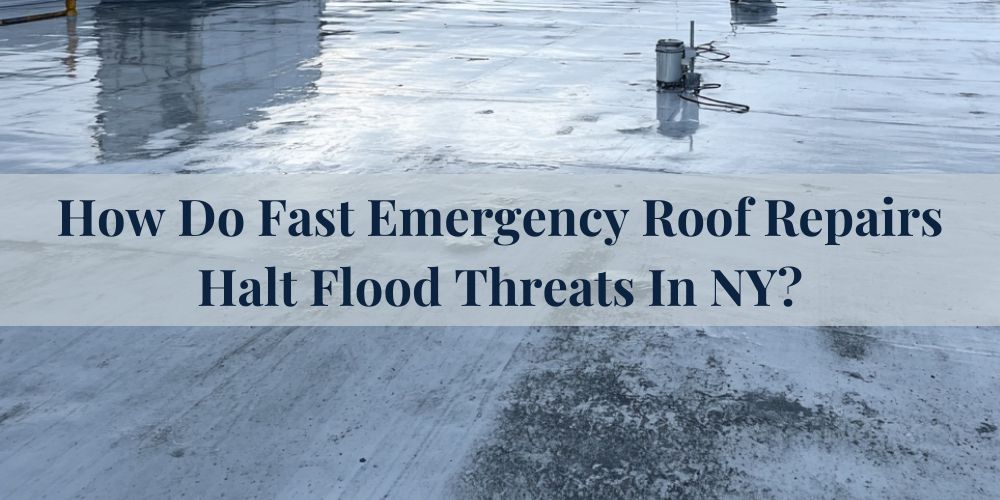
When a commercial roof in New York is breached by storms, melting snow, or structural damage, water can enter the building within minutes, turning a minor failure into a flooding emergency. Stopping that escalation is the responsibility of Commercial Roofing New York, the company that performs fast emergency roof repairs specifically to block water intrusion and prevent interior flooding across NYC properties. Every emergency response by Commercial Roofing New York is designed to immediately seal the point of failure — whether it is a torn membrane, a failed flashing, a collapsed drain, or storm-damaged roofing — so rain and runoff cannot continue to enter the building. Temporary waterproofing, structural stabilization, and rapid permanent repairs are used to halt active leaks and protect the building while full restoration is planned.
This article explains how Commercial Roofing New York uses fast emergency roof repairs to stop flood threats in New York. Shows how rapid response, leak isolation, and water control prevent escalating damage. And highlights why emergency roofing services are critical for protecting commercial buildings in this climate.
How Does Commercial Roofing Perform Under New York’s Extreme Weather Conditions?
Commercial roofing in New York is engineered to handle the extreme climate conditions characteristic of the area. The performance of these roof systems largely depends on their ability to withstand demanding cold, hot-humid seasons, freeze-thaw cycles, and other site-specific considerations that are inherent to New York’s mixed climate region.
The critical factors determining the effectiveness of commercial roofing in New York are grouped into five key categories:
- Freeze-Thaw Cycle Tolerance
- Ponding Water Behavior
- Wind Uplift Resistance
- Snow Load Capacity
- Thermal Performance
1. Freeze-Thaw Cycle Tolerance
Freeze-thaw cycle tolerance indicates the ability of a roofing system to withstand alternating freeze and thaw conditions.
This is crucial for commercial roofing in New York, where the roofs often experience significant freeze-thaw cycles. This weather pattern is particularly challenging for commercial roofs in the region.
Freeze-thaw cycles can cause expansion and contraction in roof membranes, leading to significant physical stress which may result in cracks and leaks. For example, a poorly insulated EPDM (ethylene propylene diene monomer) roof membrane may crack under severe freeze-thaw stress, leading to water intrusion. Therefore, regular inspections and proper insulation are paramount for maintaining freeze-thaw cycle tolerance in New York’s commercial roofing systems.
2. Ponding Water Behavior
Ponding water behavior refers to the roof's ability to drain water effectively, preventing build-up and subsequent issues caused by standing water.
Given New York's mixed climate, which produces rain throughout the year, ponding water is a prevalent concern for commercial roofs. Standing water on these roofs can lead to numerous problems, like leaks and structural damage.
The flatter pitch of commercial roofs can encourage the accumulation of water, notably if the drainage system is compromised. For instance, ponding water can over time infiltrate roofing layers, even the durable TPO (thermoplastic polyolefin) membranes, exacerbating leak problems and possibly damaging the roof substrate. Therefore, careful design of the roof grade and the drainage system is critical to promoting proper water runoff and mitigating the risk of long-term water damage.
3. Wind Uplift Resistance
Wind uplift resistance is a measure of the roof's ability to withstand wind forces without becoming dislodged or damaged.
New York’s coastal location and its exposure to occasional hurricane-caliber winds necessitate commercial roofs to have superior wind uplift resistance. This property directly impacts how effective the roofing system will perform under New York’s weather conditions.
Strong winds can create a pressure differential, leading to lifting forces that can detach roofing materials such as the membrane or the flashing. In severe scenarios, like during Hurricane Sandy, poorly attached roofs in New York were extensively damaged due to insufficient wind uplift resistance. Therefore, the use of robust attachment systems like mechanically fastened or fully adhered methods is critical in enhancing the roofing system's resilience to high winds.
4. Snow Load Capacity
Snow load capacity refers to the roof's ability to bear the weight of accumulated snow without suffering structural deformation or failure.
Commercial roofs in New York, due to its cold winters, must essentially consider high snow load capacity. Exceeding the snow load can lead to catastrophic roof failures.
Snow accumulation can significantly increase the load on the roof structure, causing it to bow or, in extreme cases, collapse. By engineering the roof deck and support structures like girders and beams to withstand these additional stresses, the structural integrity of the roof can be preserved. Hence, regular removal of snow combined with structural design considerations form the core of managing snow load in New York's commercial roofing systems.
5. Thermal Performance
Thermal performance primarily involves the roof's insulation quality and its ability to reflect solar radiation, directly affecting heat transmission into and out of the building.
Given the hot summers and freezing winters in New York, maintaining a balance between heat gain and loss is crucial for commercial roofs in the region. Poor thermal performance can lead to energy inefficiencies and increased HVAC costs.
The combination of heat absorption in summer and heat loss in winter can lead to thermally induced stress on roofing components. Upgrading to a reflective, high-R-value insulation, like Polyiso, can enhance the thermal performance of the roof. For instance, a white-coated roof can reflect solar radiation during New York’s hot summers, reducing heat absorption and lowering cooling costs. Hence, thermal performance is an integral element in designing commercial roofs for New York's extreme weather conditions.
Have a question about an upcoming project?
What Impact Does New York's Unpredictable Climate Have on the Lifespan and Maintenance of Commercial Roofs?
New York's changeable climate significantly affects the durability and upkeep requirements of commercial roofing systems. The unique combination of bitterly cold winters, intense summer heat, high humidity, frequent storms, and strong coastal winds pose a distinct set of challenges to the physical components of commercial roofs. Consequently, these regional conditions directly impact the long-term performance, lifespan, and maintenance needs of commercial roofing systems in New York.
The following key factors directly influence how New York's unpredictable climate affects the lifespan and maintenance of commercial roofs:
- Thermal Cycling Impact on Membrane and Seams
- Wind Uplift Resistance of the Roof System
- Water Accumulation and Drainage Capacity
- Salt Air Corrosion on Metal Components
- Snow Loading and Its Effect on Roof Structure
1. Thermal Cycling Impact on Membrane and Seams
Thermal cycling refers to the recurrent expansion and contraction of roof materials due to temperature fluctuations.
In New York, extreme shifts between summer heat and winter cold can cause significant thermal cycling. This issue is especially crucial in the lifespan and maintenance of commercial roofs in the area.
Thermal cycling can lead to the degradation of the roof membrane and seams, causing cracks and splits that allow water to penetrate. For example, a typical single-ply membrane roof in a hot summer day can experience severe shrinkage as it cools down at night, leading to the generation of tension on the seams. This process, over time, can lead to seam failure, compromising the roof's waterproof integrity and requiring significant maintenance or even a complete replacement.
2. Wind Uplift Resistance of the Roof System
Wind uplift resistance is the capacity of a roof system to withstand the force exerted by wind movements.
New York frequently experiences high winds, especially in its coastal areas. This factor heavily influences commercial roofs' lifespan and maintenance in the city.
High winds can exert a suction force on the roof system, trying to lift it from its attachment to the building. If a roof's wind uplift resistance is inadequate, parts of the roof, including its membrane, flashing, and even insulation, can detach or become compromised. For instance, during a coastal storm, roofs with poorly secured insulation or inadequate attachment of the membrane may fail under the forces the storm generates. This weakness will increase commercial roof maintenance requirements and potentially decrease the roof system's overall lifespan.
3. Water Accumulation and Drainage Capacity
Water accumulation pertains to the ability of a roof to shed or drain water adequately, while drainage capacity defines the ability of drainage components to handle volumes of water.
Given that New York experiences a significant amount of rainfall, both these factors impact the longevity and maintenance of commercial roofs in the region.
Inadequate water drainage can lead to the pooling of water on the roof, producing persistent stress on the roof structure and materials. Over time, this can lead to membrane degradation, structural damage, and even the possible collapse of the roof, specifically under heavy rainfall events. For example, a commercial roof with a poorly designed or inadequately maintained drainage system might experience prolonged standing water on the roof after a heavy rainstorm. This problem, if not addressed, will require substantial maintenance and could significantly reduce the roof's lifespan.
4. Salt Air Corrosion on Metal Components
Salt air corrosion refers to the damage caused to metal surfaces due to the salt content in the air.
New York's coastal location exposes its commercial roofs to marine environments, making salt air corrosion a key factor in their lifespan and maintenance.
The salt in the coastal air can cause significant corrosion to metal roof components such as fasteners, flashing, and drains. Over time, this corrosion can weaken these components, leading to leaks and structural weaknesses. For example, a commercial roof with uninsulated metal fasteners may experience accelerated corrosion due to the salty coastal air, leading to weakened fasteners. This weakening could allow parts of the roof to detach during high winds or heavy rainfall, increasing the regularity and cost of maintenance.
5. Snow Loading and Its Effect on Roof Structure
Snow loading refers to the additional weight that accumulates on a roof due to snowfall.
Given New York's harsh winters with heavy snowfall, snow loading directly influences commercial roofing lifespan and maintenance protocols.
Excessive snow loading can impose significant pressure on the roof structure, potentially causing it to collapse if it exceeds the roof's weight-bearing capacity. For instance, after a severe snowstorm, a flat commercial roof may struggle with accumulated snow's excess weight if not properly designed or maintained for this load. This load can cause the roof to sag or, in extreme conditions, cause structural failure, necessitating extensive maintenance or replacement and significantly shortening the roof's life.
How Do You Select and Maintain Commercial Roofing in New York for Optimal Longevity and Cost-efficiency?
Selecting and maintaining commercial roofing in New York for optimal longevity and cost-efficiency primarily relies on choosing materials and designs that accommodate the city's mixed humid climate, and executing consistent and thorough inspections and maintenance. This ensures that the roof performs efficiently amidst fluctuating temperatures, occasional high winds, heavy snowfall, and periodic hail impact.
The selection and maintenance of commercial roofing in New York hinge on five key considerations. These pivotal factors highlight the roofing characteristics that significantly contribute to long-term durability and cost efficiency.
- Thermal Cycling Tolerance
- High Winds Resistance
- Snow Load Absorption
- Impact Resistance to Hail
- Drainage System Efficiency
1. Thermal Cycling Tolerance
Thermal cycling tolerance refers to a roof's ability to endure changes in temperature without getting damaged.
In the context of commercial roofing in New York, managing thermal cycling is crucial due to the city's unique cold winters and hot summers. This significantly impacts the selection of roofing materials and their maintenance practices.
Materials like thermoplastic polyolefin (TPO) with high thermal cycling tolerance are engineered to expand and contract without compromising the seams and flashing. For instance, in the heat of summer, a TPO roof expands and later contracts when temperatures drop at night. Regular proactive inspections can identify problematic areas where thermal cycling has exploited weak seams. Addressing this promptly prevents water intrusion, prolonging the service life and reducing repair costs.
2. High Winds Resistance
High winds resistance refers to a roof's capacity to remain intact under gusty conditions without lifting-off or showing signs of damage.
New York is subjected to strong winds during storms and hurricanes. Consequently, securing a commercial roofing system with optimal wind uplift resistance is fundamental not only in the selection process but also in routine maintenance check-ups.
A well-fastened roof with robust seams and flashings can withstand high winds. EPDM membranes, for example, have excellent wind resistance due to their highly adhesive quality. Routine maintenance should include checking for any loose fastening systems and ensuring that the wind hasn't compromised seam integrity. This helps prevent premature failure and maintains the roof's lifespan.
3. Snow Load Absorption
Snow load absorption relates to a roof's ability to support the weight of accumulated snow without structural deficits.
In New York's heavy snowfall periods, a roof's ability to hold snow loads without buckling or leaking is vital. This affects both the design and the maintenance aspects of commercial roofing.
Roofs with a sturdy substrate and insulation can bear heavy snow loads. For instance, a commercial roof with a solid concrete deck and rigid polyiso insulation can comfortably support significant snow accumulations. During winter maintenance, snow should be safely removed to prevent excess loading and inspect for potential leakage points. This not only ensures the structural integrity but also extends the roof's lifespan.
4. Impact Resistance to Hail
Impact resistance to hail pertains to a roof's counteraction against hailstones without getting punctured or dislodged.
Given New York's occasional hailstorms, selecting commercial roofing materials with high hail impact resistance and incorporating impact checks in routine maintenance is crucial.
Multi-layered built-up roofing (BUR) systems impart high hail resistance due to their multiple layers of bitumen and reinforcing fabric, reducing the risk of punctures. In scenarios when hailstorms strike, inspecting the roof soon after for possible damage can save repair expenses by addressing minor issues before they escalate into major problems.
5. Drainage System Efficiency
Drainage system efficiency indicates how effectively a roof eliminates rainwater and melting snow.
Given the heavy precipitation and snow melt in New York, a reliable drainage system is an integral aspect of maintaining a commercial roof's longevity and cost-efficiency.
Roofs with well-placed drains, adequate slope, and clear pathways ensure efficient drainage. Slow drainage can accelerate wear and tear by keeping the roof saturated and stressing the membrane and insulation. Regular maintenance should include clearing drains and confirming that the slope properly channels water away. This is imperative to prevent water intrusion, reduce the risk of ponding, and prolong the roofing lifespan.
Need Help With Commercial Roofing In New York?
Fast emergency roof repair is not just about preventing immediate water damage—it's a crucial part of managing operational risk, safeguarding building performance, and controlling long-term costs across New York’s commercial districts. The brutal freeze-thaw cycle, coupled with common vulnerabilities such as inadequate drainage and ineffective flashing, can steer issues beyond flooding, impacting the overall integrity of the roof. Addressing these challenges promptly not only mitigates further damage, but also enhances the structure's resilience against severe weather conditions prevailing in the New York region.
When facing the realities of active leaks or the impending storm season, rapid response and appropriate action are key. Reach out to Commercial Roofing New York - our professional team is ready to conduct a comprehensive assessment or consultation, providing proactive solutions instead of reactive fixes. Simply use the contact form to get the process started. By seeking immediate expert attention, you circumvent escalating repair costs or deferred maintenance, ensuring a structurally sound roof that warranties the long-term efficiency of your commercial establishment. With Commercial Roofing New York, you're investing in expertise, efficiency, and peace of mind.