
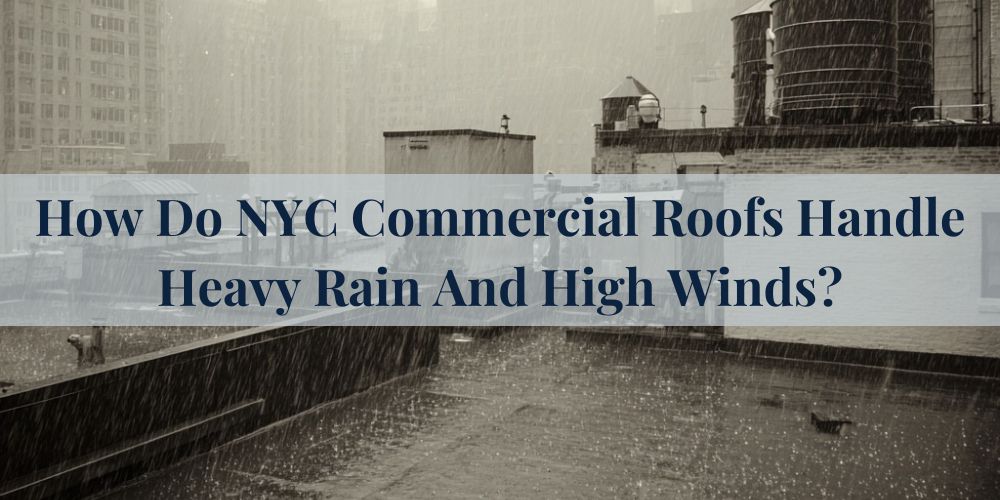
Heavy rain and high winds place constant stress on New York commercial roofs by forcing water across roof surfaces and pushing upward on membranes, seams, and fasteners. Managing those forces is the responsibility of Commercial Roofing New York, the company who design, install, and maintain commercial roofing systems specifically to keep NYC buildings sealed and stable during severe weather.
Every roof built by Commercial Roofing New York is engineered to move water off the roof quickly while resisting wind uplift that can tear poorly secured systems apart. Drainage layouts, membrane attachment methods, flashing details, and perimeter edge systems are selected to prevent ponding, block wind driven rain, and keep the roof assembly intact during storms. This article explains how Commercial Roofing New York protects New York commercial buildings from heavy rain and high winds. It explains how roofing systems are designed to shed water and resist uplift. And why these design choices are essential for keeping properties dry and operational in this climate.
How Does Commercial Roofing Perform Under New York's Severe Weather Conditions?
Commercial roofing systems in New York perform variably depending on their engineering, material selection, and maintenance practices. Harsh weather conditions create unique challenges, particularly given the city's cold, mixed-climate region, freeze-thaw cycles, and significant storm exposure.
The key factors affecting commercial roofing performance under New York's severe weather include the roof's structural integrity, the membrane's thermal cycling response, wind uplift resistance, resilience to freeze-thaw cycles, and stormwater management capabilities:
- Roof Steel and Concrete Substrate Condition
- Single-ply Membrane Thermal Cycling Response
- Wind Uplift Resistance
- Freeze-thaw Cycle Resilience
- Stormwater Management via Roof Drains and Slope
1. Roof Steel and Concrete Substrate Condition
The substrate is the basic structural element of the roof, typically composed of concrete or steel decking.
In New York's mixed-climate, the substrate often bears substantial loads from heavy snowfalls and stormwater accumulations, making its condition critical to the overall roof performance. Substrates also need to withstand typical urban stresses like air conditioning units, rooftop traffic, and constant vibration from nearby trains or traffic.
When exposed to moisture, steel substrate can erode, compromising the anchor point for fasteners and weakening the integrity of the roof membrane, causing leaks. Routine inspections for rust, warping, or other signs of damage can prevent these issues, while using a concrete substrate can offer superior resistance to variable loads and environmental conditions.
2. Single-ply Membrane Thermal Cycling Response
Commercial roofs often employ single-ply membranes, like TPO or PVC, which must withstand a wide range of thermal loads due to daily and seasonal temperature variances.
New York's climate delivers a spectrum of thermal stress through its sweltering summers and freezing winters, which can test a membrane's thermal cycling response. If roofs continually expand and contract, this can lead to premature ageing and crack formation, eventually resulting in leaks.
A well-engineered single-ply membrane will maintain elasticity over a wide temperature range, minimizing these issues. Regular inspections can also detect thermal degradation early, and prompt repairs can help maintain the membrane's integrity under New York's temperature extremes.
3. Wind Uplift Resistance
Wind uplift resistance refers to a roof's ability to withstand the wind pressure without detaching or experiencing excessive deformation.
With New York commonly experiencing strong winds during storms, roofs must offer significant wind uplift resistance to prevent system failures. Torn or uplifted roofing can expose the substrate and interior, leading to significant water or wind damage.
Roofing materials, especially single-ply membranes, must be properly secured with wind-rated fasteners and adhesive, while edge metal and flashings should be robustly attached to prevent wind entry points. Regular inspections also enable timely replacement of compromised components and ensure the roof maintains its wind uplift resistance.
4. Freeze-thaw Cycle Resilience
Freeze-thaw cycle resilience refers to a roofing system's ability to repeatedly freeze and thaw without degradation or failure.
New York's hard winters place commercial roofs under constant freeze-thaw stress, challenging the materials and components of the roofing system. Freeze-thaw cycles can damage adhesives, crack membranes, and erode flashings, leading to leaks or system failure.
Choosing materials with high freeze-thaw resilience, regular checks for moisture infiltration, and prompt repair of any damage spotted can help maintain a roofing system. It's ideal to employ a membrane and flashings which remain flexible in freezing temperatures, to facilitate the roof's overall long-term performance in New York's harsh climate.
5. Stormwater Management via Roof Drains and Slope
Stormwater management refers to the roof's design and maintenance for dealing with rainwater or melting snow.
New York's stormy weather and significant snowfall often overload roofing systems with stormwater. Subpar stormwater management leads to ponding, increased load, and deteriorated substrates, compromising the roof's integrity.
A commercial flat roof should have a well-designed slope for drainage, along with sufficient and well-maintained roof drains. Regular inspections for debris blockages and efficient removal of accumulated snow can prevent water ponding and substrate damage, enhancing the roof's overall performance in severe weather conditions.
Have a question about an upcoming project?
What Implications Do New York's Humidity and High Winds Have on Commercial Roof Lifespan?
New York's humid conditions and strong winds directly impact the lifespan of commercial roofs by accelerating wear and loss of structural integrity. These climatic factors test the roof's resistance to moisture, wind uplift, thermal cycling, algae growth, and its ability to drain properly. The region's weather patterns, therefore, pose unique challenges to roofing components like the membrane, flashing, and insulation.
Delving deeper into these implications, five key factors emerge that directly answer the question at hand:
- Moisture Resistance
- Wind Uplift Resistance
- Thermal Cycling Tolerance
- Algae Growth Resistance
- Drainage Capacity
1. Moisture Resistance
Moisture resistance refers to a roof's ability to repel water and dampness, protecting structural components from damage.
With New York's high humidity levels, frequent rainfall and snowfall, ensuring moisture resistance is crucial for prolonging a commercial roof's lifespan. The ongoing exposure to moisture can degrade the roof's components such as membranes and insulation.
Water that seeps into the roof system is a catalyst for deterioration and can lead to issues like membrane swelling or waterlogging of insulation. Real-world instances are plentiful in the northeast wherein damp conditions combined with poor moisture control have led to compromised roof systems. Properly quality-checked membrane installations and moisture-resistant insulation materials such as closed-cell spray foam can help mitigate these effects.
2. Wind Uplift Resistance
Wind uplift resistance signifies a roof's ability to withstand the forces exerted by high-speed winds without being pulled up or damaged.
In New York, the ability to resist high winds is essential due to its exposure to harsh coastal winds and periodic hurricanes. These conditions directly challenge the roof's fasteners, seams, and overall attachment system.
Wind uplift occurs when wind flows over the roof, creating a pressure difference that lifts the roofing components. If seams aren't properly sealed or fasteners aren't strong enough, the winds can trigger gradual to extensive damage. Commercial buildings in New York City that have roof terraces face this risk, particularly in hurricane season. To combat these conditions, wind-rated assemblies and robust fastening strategies should be prioritized in specification and maintenance routines.
3. Thermal Cycling Tolerance
Thermal cycling tolerance refers a roof's capacity to withstand the expansion and contraction caused by temperature fluctuations without cracking or peeling.
New York's change of seasons, contributing to wide-ranging temperatures, tests the thermal cycling tolerance of commercial roofs, specifically the membrane and substrate.
Thermal swings lead to repeated expansion and contraction, which can induce fatigue in roofing materials and crack or rupture the membrane. For example, during a typical New York winter, the roof may endure below freezing temperatures at night and then a significant rise in daytime temperatures. Specifying materials with high thermal shock resistance, like EPDM or TPO membranes, contributes significantly to mitigating these effects.
4. Algae Growth Resistance
Algae growth resistance is the degree to which a roof can counteract the establishment and proliferation of algae.
High humidity, like the conditions found in New York, contributes to the growth of algae, which can compromise the roof's coating and underlying materials.
Algae growth can lead to unsightly roof discoloration and potential damage due to the microorganism's tendency to break down materials. Green roofs in New York City, if not regularly serviced, can suffer from algae overgrowth. Efforts to counter algae include the specification of algae-resistant roof coatings and regular maintenance to ensure proper cleanliness.
5. Drainage Capacity
Drainage capacity is a roof's ability to effectively shed or channel off water to reduce pooling.
A strong drainage system is extremely important in New York due to its high precipitation levels that put pressure on the roof's drains and slopes.
Poor drainage capacity can lead to standing water or 'ponding', which increases the chance of leaks and accelerates material breakdown. For example, flat commercial roofs in Manhattan, after heavy rainstorms, can turn into areas of water pooling. Ensuring that roof surfaces have proper pitching and that drain systems are regularly cleared can help prevent such problems and ultimately enhance the roof's lifespan.
How to Choose and Maintain Commercial Roofing for Optimal ROI in New York's Climate?
Selecting the right roof system that can handle weather extremes together with regular preventive maintenance are keys to maximizing the return on investment (ROI) in New York's variable climate. The city experiences cold, wet winters, hot, humid summers, and occasional extreme weather conditions such as hurricanes and snowstorms. This requires careful choice of roofing materials, design, and maintenance.
By strategically considering the following five factors during roof system selection and maintenance, it is possible to have a commercial roof that withstands New York's climate and delivers optimal ROI.
- Wind Uplift Resistance
- Thermal Cycling Tolerance
- Ponding Water Behavior
- Seasonal Damage Mitigation
- Seam Integrity
1. Wind Uplift Resistance
Wind uplift resistance refers to a roof system's ability to resist wind pressures trying to lift it off the building structure.
In New York, hurricanes and severe storms can produce substantial wind forces. Properly designed and installed roof systems that feature secure attachment methods and high-strength fasteners can significantly reduce the risk of blow-offs and membrane damage.
Average wind speeds in New York City can reach up to 12 miles per hour, but gusts during storms can significantly exceed those speeds, causing substantial uplift force. Systems such as mechanically attached single-ply membranes resist wind uplift by distributing this force evenly through strong fasteners and plates. Regular maintenance should inspect these components for wear and security to mitigate the risk of uplift damage over time.
2. Thermal Cycling Tolerance
Thermal cycling tolerance refers to a roofing system's ability to endure frequent temperature changes without performance degradation.
New York's climate is characterized by freezing winters and hot, humid summers. A roofing system that can tolerate these temperature fluctuations with minimal expansion and contraction will result in fewer stress-related damages like membrane cracking.
Membranes such as TPO and EPDM have excellent thermal cycling tolerance due to their inherent material flexibility. They can accommodate the expansion and contraction without compromising the integrity of seams and attachments. Regular inspections can identify any signs of thermal stress like buckling or shrinkage early, allowing for timely repairs and enhancing the lifespan of the roofing system.
3. Ponding Water Behavior
Ponding water behavior refers to how a roofing system handles water that remains on the roof surface 48 hours after a rainfall has ended.
Heavy rainfalls and snow melting can leave standing water on rooftops in New York. Choosing a roof system that allows for effective drainage and uses materials that can resist water damage will extend the roof's lifespan.
Proper roof design and installation can prevent ponding and promote drainage. Coatings and membranes resistant to water deterioration and still demonstrate performance in wet conditions are essential for New York climates. Maintenance checks should include ensuring drains are clear and the roof's slope is allowing for effective water movement.
4. Seasonal Damage Mitigation
Seasonal damage mitigation refers to a roofing system's ability to withstand different seasonal climate changes and related weather events.
New York experiences a wide range of weather conditions, from freezing winter temperatures to hot humid summers, and even severe weather such as hurricanes. Therefore, a multilayered roof system with high-quality insulation, robust flashing, and tough membranes provides an all-weather defense layer.
For example, a roof system featuring a PVC membrane can provide excellent weather resistance, due to the membrane's inherent strength and flexibility. A thick layer of insulation is crucial for winter periods to prevent heat loss and ice damming. Seasonal inspections are important to ensure all components are upholding their defensive function as expected.
5. Seam Integrity
Seam integrity refers to the quality of the bonds that connect individual sheets of a membrane, ensuring a continuous, leak-proof roofing surface.
Accurate seam construction and maintenance are critical in a location like New York due to its variable weather conditions. High and low temperatures, rain, snow, and wind can all compromise seam integrity over time.
Roofing systems utilizing heat-welded or fully adhered seams, such as TPO and PVC roofing systems, provide robust and reliable seam connections that resist environmental stresses. Routine maintenance checks should include inspecting seams for any signs of weakness or failure, allowing for early detection and repair, thereby preserving the overall integrity of the roof system.
Need Help With Commercial Roofing In New York?
Commercial roofs in New York are an engineering marvel designed to withstand the city's intense climate, dramatically mitigating operational risk and enhancing building performance. These roofs are especially constructed to resist high winds and heavy rain, safeguarding properties from the harsh elements. However, aspects like poorly installed flashing and insufficient drainage systems can potentially compromise their hardiness, leading to unnecessary long-term costs. Furthermore, a roof's vulnerability to wind uplift and the relentless cycle of freezing and thawing are crucial aspects demanding meticulous attention. New York, firmly situated in a mixed climate region of the U.S., experiences significant weather swings making the longevity and resilience of its commercial roofs essential.
If you're facing issues related to aging roofs, or anticipate complications due to the upcoming storm season, waiting longer could mean escalated repair costs. Act now, and let the experts at Commercial Roofing New York evaluate your specific needs. Our trusted professionals can conduct a thorough inspection and provide needed assessments or consultations to fortify your building against the adverse weather conditions common in New York. To book an appointment or learn more about our offerings, use the contact form on our website. Remember, timely intervention can save you from the strain of deferred maintenance, and lead to significant savings in the long run.