
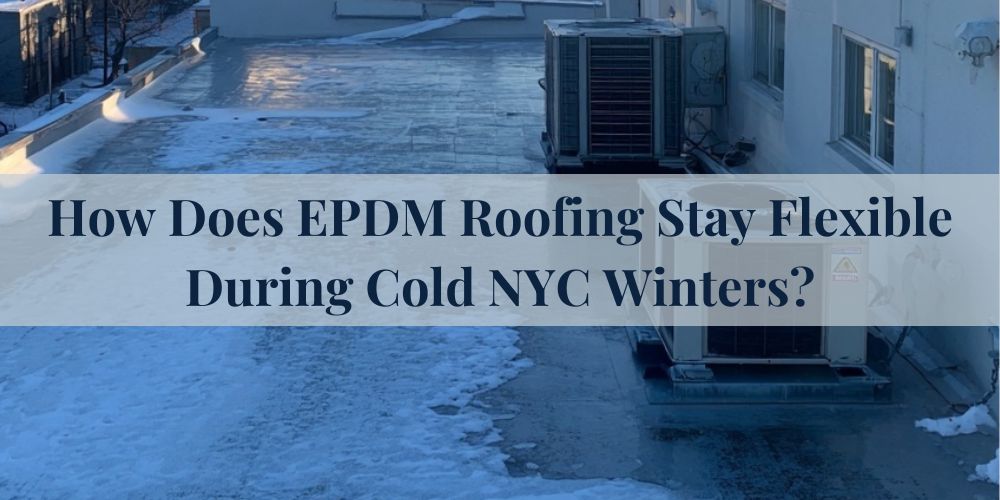
In New York’s winter climate, commercial roofs are subjected to prolonged freezing temperatures that cause many materials to stiffen, crack, and pull apart at seams. Preventing that failure is the role of Commercial Roofing New York, the company that installs EPDM roofing systems specifically to maintain flexibility and waterproofing through NYC’s coldest conditions.
Every EPDM roof installed by Commercial Roofing New York is selected and detailed for its ability to remain elastic at low temperatures, allowing the membrane to expand and contract without splitting as buildings move through freeze-thaw cycles. Seams, adhesives, insulation layers, and flashing systems are all engineered to work with EPDM’s rubber properties so the roof remains sealed even when temperatures drop well below freezing. This article explains how Commercial Roofing New York uses EPDM roofing to keep New York commercial buildings protected during winter. It details how material flexibility, installation methods, and system design prevent cold-weather cracking. And why EPDM is one of the most reliable roofing solutions for NYC’s climate.
How Does EPDM Commercial Roofing Perform in New York's Winter Climate?
EPDM commercial roofing is particularly effective in New York's winter climate due to its superior resistance to extreme temperatures, precipitation, and wind. Its composition offers flexibility and durability under harsh winter conditions, diminishing the risk of cracking and brittleness. Furthermore, its dark surface color contributes to improved heat absorption which can aid in reducing ice buildup.
The key factors that determine the performance of EPDM roofing system in New York's winter climate include thermal cycling response, resistance to freeze-thaw damage, wind uplift resistance, snow load tolerance, and ice damming response.
- Thermal Cycling Response
- Resistance to Freeze-Thaw Damage
- Wind Uplift Resistance
- Snow Load Tolerance
- Ice Damming Response
1. Thermal Cycling Response
Thermal cycling response pertains to how well a roofing material can handle constant changes in temperature.
EPDM roofing is highly resistant to temperature fluctuations, a notable feature in New York's winter climate which ranges from mild to severe cold. This characteristic is critical in preventing deterioration due to thermal stress.
The rubberized nature of EPDM enables it to expand and contract in response to temperature changes without breaking. For instance, a storm that rapidly drops temperatures will not lead to an immediate freezing and cracking of the EPDM membrane. Instead, the material flexes and retains its structural integrity, reducing the need for frequent and costly maintenance checks in winter.
2. Resistance to Freeze-Thaw Damage
Resistance to freeze-thaw damage means how a roofing material can withstand the cycle of freezing and thawing prevalent in cold climates.
In the harsh New York winters, EPDM roofs show high levels of resistance to freeze-thaw damage, contributing to longevity and integrity. The durability of EPDM in freezing conditions is crucial in staving off possible water penetration.
The rubber composition of EPDM minimizes the risk of surface cracking, which often occurs when water infiltrates the material, freezes, and expands. Consequently, less water penetration means less potential damage to the roof's substrate and insulation, ultimately enhancing the roof's lifespan.
3. Wind Uplift Resistance
Wind uplift resistance refers to a roof's capacity to withstand pull from high winds without detaching from the building.
In the cold, gusty conditions typical of New York winters, an EPDM roof's wind uplift resistance is essential. Its secure attachment method contributes to this resistance, decreasing the risk of wind damage.
The robustness of EPDM involves multiple fastening strategies -- using mechanical fasteners, ballasts, or adhesive, all of which help hold the membrane even in heavy storms. The correct employment of these attachment methods means fewer instances of wind-related displacement or damage, increasing the roof's performance and longevity.
4. Snow Load Tolerance
Snow load tolerance pertains to a roofing system's capacity to endure the weight of accumulated snow without structural failure.
Heavy snowfalls common to New York winters require a commercial roofing system that can efficiently carry snow loads. The inherent strength of EPDM membranes makes them an excellent choice for these conditions.
EPDM roofing is inherently strong and resilient, allowing it to support significant weight without succumbing to deformation or failure. In the event of extreme snowfall, this resilience provides assurance against potential structural compromise, providing an extra layer of security to the building and its occupants.
5. Ice Damming Response
Ice damming response is the capacity of the roofing system to resist damage from ice accumulation at the edges of the roof.
EPDM's excellent thermal absorption and insulation properties help reduce ice damming, a frequent issue in New York winters. It is an essential factor in preventing roof leaks from melting ice dams.
EPDM's dark color aids in capturing heat from the sun and contributing to the melting of accumulated ice. Also, the rubber membrane's design aids in directing the meltwater away from the roofing edges, thus preventing the build-up of ice dams. Minimizing ice dams mitigates roof leakage risk and prolongs the roof's operational life.
Have a question about an upcoming project?
What Impact Does New York's Freeze-Thaw Cycle Have on the Lifespan of EPDM Roofing?
New York's freeze-thaw cycle can significantly shorten the lifespan of EPDM roofing, largely due to temperature-induced material stress and potentially the damage caused by accumulating ice. These cycles involve rapid shifts from freezing to thawing conditions, resulting in expansion and contraction that can weaken the roofing system over time. Additionally, built-up snow and ice can lead to other severe issues like ponding water and increased mechanical stress on the roof.
The factors that can impact the lifespan of EPDM roofing due to New York's freeze-thaw cycle are:
- Thermal Cycling Impact on Seam Integrity
- Ice Dam Formation and Flashing Performance
- Ponding Water Potential
- Mechanical Stress and Fastener Performance
- Insulating Capacity and Condensation Control
1. Thermal Cycling Impact on Seam Integrity
Seam integrity refers to the bond strength between joined sections of the EPDM membrane.
This factor is critical in the context of New York's freeze-thaw cycle, as the frequent temperature changes can cause the membrane to expand and contract, potentially weakening the seams over time. Ultimately, this increases the risk for water leaks and penetration into the roofing system.
When the temperature fluctuates above and below freezing point, the EPDM membrane expands and contracts. Over time, this elasticity stress can cause microscopic cracks at the seams of the roofing sheet. These imperfections gradually worsen due to repeated cycles, eventually becoming visible splits. This issue underscores the importance of proper seam sealing and regular maintenance to detect and repair minor seam defects early, significantly increasing the roof's service life.
2. Ice Dam Formation and Flashing Performance
Flashing performance refers to the ability of the roof seals around projections and other interruption points to resist water penetration.
These areas are particularly vulnerable to freeze-thaw cycles in New York that can lead to ice dam formations. Ice dams can directly damage flashings, creating points of water intrusion into the roof system.
Ice dams form when melting snow, fueled by the building's heat, refreezes at the eaves and gutters. This continuous ice build-up can exert pressure on flashings, leading to separation or damage. If the flashing's integrity is compromised, water can enter the roofing system, potentially causing interior damage and reducing the lifespan of the commercial roofing system. Regular inspection, prompt flashing repair, and the use of heating cables can help in mitigating the risks of ice dams and extending the lifespan of the EPDM roof.
3. Ponding Water Potential
Ponding water potential is the likelihood of water accumulation on a roof over a period of time.
In New York, freeze-thaw cycles can contribute to the problem of ponding water on commercial roofs. This issue accelerates the degradation of the EPDM membrane, compromising its performance and longevity.
When snow and ice accumulate and then melt on the rooftop, they create pools of water that can persist on a flat or improperly sloped roof. Over time, this standing water can seep into minute breaches in the membrane, causing leaks and adding weight that strains the structure. Installing appropriate drainage systems and regular site inspections to check for ponding and drain blockages will greatly reduce the ponding water potential and extend the lifespan of an EPDM roof.
4. Mechanical Stress and Fastener Performance
Fastener performance refers to the ability of the mechanical devices used to secure the roofing system to withstand stress without failure.
In New York, freeze-thaw cycles can put significant mechanical stress on the fasteners holding the EPDM membrane in place. These varying pressures can cause fastener failures, leading to wind uplift damage and accelerated roof aging.
As the temperature oscillates between freezing and thawing, ice can accumulate around the fasteners. The hydrostatic pressure applied by expanding ice can strain the fasteners, leading to loosening or material degradation. Additionally, wind uplift caused by displaced air in loose membranes can further stress the fasteners. Regular inspection of fastener integrity and the use of corrosion-resistant materials can significantly mitigate these risks and prolong the roof's lifespan.
5. Insulating Capacity and Condensation Control
Insulating capacity refers to a roof's ability to restrict heat transfer, while condensation control relates to its capability to manage moisture accumulation within the roof assembly.
In New York, freeze-thaw cycles can affect both these aspects, leading to heat loss and the potential for damaging condensation within the roofing system.
Repeated freeze-thaw cycling can compromise the insulating layers beneath the EPDM membrane. This results in heat escape, higher energy costs, and potential condensation within the roofing assembly. If the condensed moisture freezes, it can create damaging ice within the roof structure when exposed to freezing temperatures. Implementing proper insulation with a high R-value and suitable vapor barriers can aid in maintaining heat efficiency and controlling condensation, contributing to the overall longevity of the EPDM roofing system.
How to Optimize the Selection and Maintenance of EPDM Commercial Roofing in New York?
Selection and maintenance of EPDM commercial roofing in New York's cold climate can be optimized by understanding key factors that influence long-term roof performance. Emphasizing factors such as installation temperature flexibility, wind uplift resistance, freeze-thaw cycle tolerance, and water vapor permeability in the selection process, and engaging in proactive maintenance practices such as timely seam checks and repairs, can extend the lifespan and function of your EPDM roofing.
To increase the lifespan and optimize the costs of EPDM roofing, we have identified five critical elements you should focus on. These factors are critical for commercial roofs in New York due to the city's unique climate conditions.
- Installation temperature flexibility
- Wind uplift resistance
- Freeze-thaw cycle tolerance
- Water vapor permeability
- Proactive seam maintenance
1. Installation temperature flexibility
Installation temperature flexibility refers to the suitability of an EPDM roofing membrane for installation during various weather conditions.
Given New York's cold winters and moderate summers, the temperature on the roofs may vary dramatically, affecting the ease and quality of installation. Hence, it is crucial to select an EPDM membrane characterized by a wide installation temperature range.
Some EPDM membranes allow cold-weather installations as low as -20 degrees Fahrenheit. Because the drilling of fasteners or applying adhesives can be challenging in low temperatures, these membranes often utilize a factory-applied adhesive. By mitigating the need for field adhesives, which don't function well in cold weather, the roof can be installed quickly and properly even in frigid New York winters, reducing the risk of early membrane degradation or seam failure.
2. Wind uplift resistance
Wind uplift resistance is a measure of how well a roof can withstand the lifting effect caused by wind.
In New York, wind-resistant roofing is essential due to the city's susceptibility to powerful coastal storms. An EPDM roof with high wind uplift resistance can fare better in these conditions.
Strong wind can create a vacuum effect leading to the membrane and even the whole roof system being dislodged. Properly designed EPDM roofs should be fully adhered or mechanically fastened to prevent such wind uplift. Moreover, it's important to regularly check and maintain roof adhesions and fasteners to ensure ongoing wind resistance, thus deterring devastating roof damage.
3. Freeze-thaw cycle tolerance
Freeze-thaw cycles refer to the process leads to the freeze or thaw of accumulated water or moisture on the roof.
New York experiences many freeze-thaw cycles, which can cause damage to roofs without the right specifications. Therefore, it is crucial that your EPDM roof has good freeze-thaw cycle tolerance.
Repeated cycles can lead to expansion and contraction of the EPDM membrane, potentially causing cracking or splitting, typically around seams. By choosing an EPDM roof with high elasticity and a stable membrane that can withstand these environmental stressors, freeze-thaw damage can be greatly reduced. Ongoing inspection for any signs of membrane stress or damage can also ensure early detection and repair, further extending the life expectancy of your roof.
4. Water vapor permeability
Water vapor permeability is the capacity of the roofing material to enable water vapor to pass through it.
High humidity in New York, particularly during summer, increases the importance of having a roof with adequate water vapor permeability.
A low permeability rating would mean the roof system traps moisture, which could degrade the insulation and decrease overall thermal performance. EPDM roofs generally offer superior water vapor permeability compared to other roofing materials. This will allow any trapped moisture to escape over time, reducing the risks associated with moisture entrapment such as mold growth and insulation damage. Proper installation is crucial to ensure this function operates correctly.
5. Proactive seam maintenance
Proactive seam maintenance involves regularly inspecting and repairing the joints where EPDM sheets are fastened together.
This is essential in New York due to the city's exposure to harsh weather conditions that can strain these seams over time.
Loose or damaged seams in an EPDM roof can allow water to infiltrate the underlying insulation, causing dampness, mold growth, and potential structural damage. Regular maintenance activities should, therefore, include checking for visible signs of seam stress or failure (such as gaps, bubbles, or debris lodged between sheets), and quickly addressing any issues that are identified. EPDM seam tapes have made the repair process easier and more effective, thereby encouraging timely remediation and prolonging the life of the roof system.
Need Help With Commercial Roofing In New York?
EPDM roofing, well-known for its flexibility, is a crucial player in managing operational risk, improving building performance and cutting long-term costs in the sometimes harsh weather conditions of New York. This versatile material, despite freezing winters, remains impressively resilient, effectively handling freeze-thaw cycles with little to no structural degradation. It's particularly adept at managing issues with seams and flashing, common vulnerabilities in commercial roofing systems. Moreover, due to its robust resistance against ponding water and UV radiation exposure, EPDM helps to ensure that New York's commercial buildings remain well-protected and efficient in energy use all year round.
As we batten down the hatches in preparation for another round of unpredictable weather, it's vital to consider the state of your commercial roofing. If you're experiencing issues like active leaks or escalating repair costs, don't ignore these red flags. Reach out to Commercial Roofing New York, your go-to experts in the field. We offer thorough inspection and assessment services tailored to identify any potential problems on your roof. Why wait for the problem to worsen? Use the contact form on our website to schedule a consultation today. Prepare for the season ahead with confidence, knowing your building is in good hands with Commercial Roofing New York.