
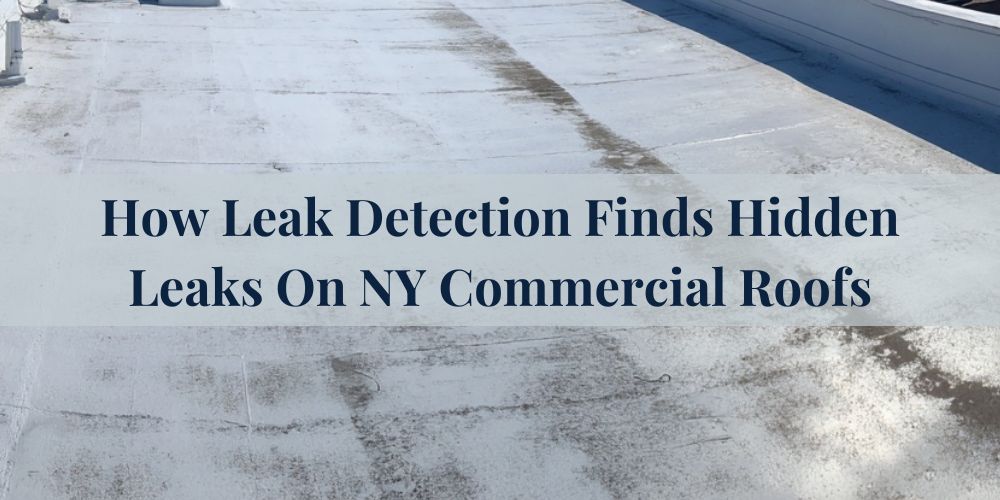
Hidden roof leaks in New York commercial buildings often develop beneath membranes, insulation, and roof surfaces long before visible damage appears inside the building. Finding those leaks before they spread is the responsibility of Commercial Roofing New York, the company that performs professional leak detection specifically to locate and stop water intrusion across NYC commercial roofs.
Every leak detection service performed by Commercial Roofing New York is designed to identify the exact point where water is entering the roof system, even when the surface appears intact. By isolating moisture pathways within the roof assembly, technicians can pinpoint failures in membranes, seams, flashing, or drainage systems and recommend targeted repairs that eliminate the leak at its source. This article explains how Commercial Roofing New York uses leak detection to uncover hidden roof leaks in New York, how advanced inspection methods reveal moisture intrusion, and why early detection is essential for preventing structural damage and costly repairs.
How Does Commercial Roofing Perform Under New York's Extreme Weather Conditions?
Commercial roofing systems designed for New York’s climate must manage unique regional challenges including intense freeze-thaw cycles, heavy snow loads, and severe storms. These factors significantly influence their performance, sustainability, and service life.
To fully understand how commercial roofing can withstand New York's weather conditions, let's examine five crucials factors that play a significant role:
- Membrane Tensile Strength
- Thermal Insulation Performance
- Seam Integrity
- Snow Load Capacity
- Wind Uplift Resistance
1. Membrane Tensile Strength
Membrane tensile strength refers to the roofing membrane's ability to resist stretching or tearing.
In New York, severe freeze-thaw cycles can strain and stress the roofing membranes. This constant expansion and contraction can jeopardize the roof's longevity and performance.
Physically, the repeated freezing and thawing process can cause less resilient membranes to crack, allowing water to infiltrate and damage the substrate. For example, in regions like the Adirondacks, where freezing temperatures persist much of the winter, a highly flexible membrane with high tensile strength is essential. Selecting a membrane with sufficient tensile strength reduces the likelihood of failure and mitigates the need for frequent repairs or replacements.
2. Thermal Insulation Performance
Thermal insulation performance determines how well the roof can prevent the transfer of heat.
In New York’s cold climate, effective insulation is critical to manage the heating requirements of commercial buildings and to safeguard the roofing system against damage caused by extreme temperature fluctuations.
When commercial roofing has inadequate insulation, it can lead to drastic temperature differences between the interior and exterior surfaces. This stress can result in distortions or cracks in the roof system. A case in point is in New York City's high-rises, where well-insulated roofs contribute positively to the building's energy efficiency while reducing the risk of thermal shock to the structure. Additionally, quality insulation aids in evenly distributing the heat on the roof surface, lessening the impact of freeze-thaw cycles.
3. Seam Integrity
Seam integrity relates to the bonding quality between separate sections of the roof membrane.
Given New York's often harsh weather conditions, especially during winter months, maintaining seam integrity is key to preventing roofing failure.
High-quality seams are resistant to weathering and can withstand extreme climate fluctuations. If seams weaken or separate due to frequent freeze-thaw cycles, they allow water and air to penetrate, causing damage. For example, after a heavy snowstorm in Buffalo, melting snow could seep into faulty seams and refreeze, bridging the gap and further worsening the damage. Regular checks and proactive maintenance can help ensure durable seam integrity, increasing the roof system's overall performance in tough New York conditions.
4. Snow Load Capacity
Snow load capacity refers to a roof system's ability to withstand the weight of snow without failing structurally.
With New York's heavy snowfall, especially in upstate areas, understanding and adhering to the snow load capacity is crucial for commercial roof performance.
Excessive snow weight can put immense pressure on the roof, straining the structures and potentially leading to roof collapse. For instance, commercial roofs in Albany routinely experience heavy snowfalls that can exceed their snow load capacity if not correctly calculated during design and construction. By considering the snow load capacity, building owners and contractors can choose the right materials and design for the roof to withstand harsh northern New York winters.
5. Wind Uplift Resistance
Wind uplift resistance is a roof’s ability to resist the force exerted by wind pressure below and above the roof surface.
In coastal regions of New York, where wind speeds can be exceptionally high during storms, roofs must have strong wind uplift resistance to avoid failure.
Without proper wind uplift design, fierce winds can create a pressure difference leading to the roof billowing or being completely detached. This phenomenon can be seen during hurricane seasons in cities like New York City, where rooftops are incredibly vulnerable to high-speed winds. Selecting a roofing system with robust fasteners, secure flashings, and strong adhesives can help reduce wind uplift, protecting the building's interior and extending the roof's lifespan.
Have a question about an upcoming project?
What Impact Do Freeze-Thaw Cycles in New York Have on Hidden Roof Leaks?
Freeze-thaw cycles in New York can accelerate the deterioration of commercial roofing systems, exacerbating hidden leaks. The alternation between freezing and thawing temperatures can amplify existing micro-cracks or vulnerabilities, compromising the integrity of the roof components. As these defects worsen under freeze-thaw conditions, a commercial roof becomes increasingly susceptible to hidden leaks.
The key factors contributing to this process can be broadly categorized into seam integrity, flashings performance, substrate resilience, insulation suitability, and coating durability. Each plays a crucial role in how freeze-thaw cycles can impact hidden roof leaks.
- Seam Integrity
- Flashings Performance
- Substrate Resilience
- Insulation Suitability
- Coating Durability
1. Seam Integrity
Seam integrity refers to the strength and reliability of the joints or overlaps between separate roofing components.
Seams are often more vulnerable to temperature fluctuations experienced during New York's freeze-thaw cycles and can harbor hidden leaks. Moreover, these weaknesses might be exacerbated by the city's frequent freeze-thaw events.
When temperatures plummet, roofing materials contract, and the stress can create or enlarge existing cracks within the seams. As the climate warms up, the resulting thaw can lead to water infiltration through these compromised areas. Regular inspections and maintenance is paramount in ensuring the longevity and effectiveness of these integral roof components in the New York climate.
2. Flashings Performance
Flashings performance pertains to the ability of flashings to maintain a leak-proof barrier at roof penetrations and peripheries despite challenging weather conditions.
In New York, flashings are often subjected to freeze-thaw cycles which can degrade their performance. This degradation can subsequently compromise their ability to contain water, therefore leading to hidden leaks.
When water freezes around flashings, it expands, potentially distorting the flashings or opening gaps where they connect with other roof components. Once temperatures rise, this ice melts and could find its path through these newly formed breaches, resulting in infiltrations. Proper installation and selected materials that can withstand freeze-thaw cycles are key factors in maintaining flashings performance in New York.
3. Substrate Resilience
Substrate resilience is the capacity of the roof's underlying structural layer to resist damage and retain its functionality despite it being subjected to harsh weather conditions.
In New York, the freeze-thaw cycles often challenge the substrate's resilience, assisting hidden leaks by exacerbating microcracks into substantial breaches.
The expansion and contraction resulting from freezing and thawing causes stress to the substrate, creating or expanding fissures. Once temperatures rise and the existing snow and ice on the roof begin to melt, water can seep through these breaches. The choice of a tough, climate-resistant substrate for commercial roofing in New York is therefore essential.
4. Insulation Suitability
Insulation suitability refers to how well the roof's insulation copes with the local climatic conditions while maintaining its insulating properties.
In the freeze-thaw cycle prevalent in New York's cold region, insulation suitability becomes critical, acting as a buffer against temperature extremes that might otherwise aggravate hidden leaks.
Inefficient insulation could allow frost penetration into the roof system, whereby water ingress can occur during thawing periods. An appropriate choice and correctly installed insulation can prevent this thereby combating the harmful effects of a freeze-thaw cycle.
5. Coating Durability
Coating durability relates to the ability of roof coatings to withstand severe weather conditions and retain their protective attributes.
Freeze-thaw cycles in New York can cause coatings to crack and flake over time, creating potential entry points for water, therefore leading to hidden leaks.
As the temperatures fluctuate, the coating contracts and expands. This constant movement can result in cracks or delamination of the coating material, leaving the underlying roof components exposed to moisture ingress when the ice melts. Regular inspection and maintenance of the protective coatings maximize their durability and, consequently, the lifespan of the roof system in New York's challenging winter conditions.
How to Maintain Commercial Roofs in New York to Prevent Leakages?
Proactive maintenance of commercial roofs entails periodic roof inspections, maintaining seam integrity, controlling ice dam formation, proper drainage planning, and utilizing appropriate membrane coatings. These actions mitigate effects of climate conditions and maximize the lifespan of the roofing system.
The key factors for maintaining commercial roofs in New York to prevent leakages are:
- Periodic Roof Inspections
- Maintaining Seam Integrity
- Controlling Ice Dam Formation
- Proper Drainage Planning
- Using Appropriate Membrane Coatings
1. Periodic Roof Inspections
Periodic roof inspections allow for early detection of potential issues that could lead to leaks.
In context of New York, a busy commercial hub, roof damage can be a common occurrence due to high wind exposure and frequent storms. Further, periods of freeze-thaw cycles can weaken the structural integrity of the roof.
Regular inspections can identify issues such as loose fasteners or damaged insulation before they escalate. For instance, upcoming extreme weather in New York would necessitate an immediate roof inspection to preemptively address any vulnerabilities. Ignoring a tiny crack on a membrane can allow water intrusion and potentially damage the substrate, hence the importance of regular inspections.
2. Maintaining Seam Integrity
Seam integrity refers to the vitality of the joints where roofing materials meet.
In New York, temperature fluctuations and severe weather can compromise the sealing of roof seams, leading to potential leaks. Moreover, high humidity can exacerbate damage to seam integrity.
When there's a failure in seam integrity, water can infiltrate the roofing system, accelerating degradation of materials such as the insulation and flashing. An example could be a poorly sealed seam that allows rainwater to seep underneath the membrane, which may result in leaks during New York's heavy rain season. It is therefore crucial to ensure seams are properly sealed during installation and maintained thereafter to uphold their integrity.
3. Controlling Ice Dam Formation
Ice dam formation is a common problem in colder regions where melting snow refreezes at the roof's edge.
During New York's cold winters, ice dams can block proper drainage of melted snow from the roof, causing water to accumulate and potentially leak into the building.
An ice dam forms when heat escaping from the building causes snow on the roof to melt, but the water refreezes at the roof edges which are typically colder. This forms a barrier that further meltwater cannot pass, resulting in pooling of water on the roof. By incorporating roof designs that prevent heat loss, utilizing exposed fasteners or incorporating heat cables, facilities can effectively prevent ice dam formation, thus averting leakages.
4. Proper Drainage Planning
Proper drainage planning means incorporating features on the roof that aid in removing water quickly and efficiently.
New York's mixed climate region requires commercial roofs to have efficient drainage systems for managing precipitation, reducing the likelihood of standing water, and preventing leakages.
The mechanism behind efficient drainage is simple - it maximizes the flow of water off the roof. This involves angling the roof or using drainage elements like internal drains or scuppers. A failure in this area can create ponding water which stresses the roof membrane and increases the chances of leaks. Therefore, an important part of roof maintenance should be to regularly clear drains from leaves and other debris, especially before and after heavy rains common to New York's climate.
5. Using Appropriate Membrane Coatings
Membrane coatings are protective layers applied on top of the roof membrane to enhance roof's resistance to various elements.
New York's climate variability necessitates the use of membrane coatings which can withstand wide temperature swings, UV exposure, and episodic heavy rains- thereby preventing roof leakage.
For instance, reflective coatings can protect the roof from the intense summer sun, while waterproof coatings can prevent water intrusion. An example is a commercial facility using a silicone coating over their roof membrane to both reflect harmful UV rays during the hot summer months and prevent water leaks during New York's rainy season. Regularly checking and applying these coatings can maximize the durability of the roof system and inhibit leaks.
Need Help With Commercial Roofing in New York?
The significance of proactive leak detection in commercial roofing, especially in New York's unique cold and freeze-thaw climate, cannot be overstated. Unseen roof leaks can cause disruptions in operations, decrease overall building performance, and result in escalating long-term repair costs. Pivotal vulnerabilities such as problematic seams and faulty flashing can allow water invasion, which over time can propagate through the roof system and into the building structure itself. Subsequently, UV exposure and ponding water can exacerbate these weak points, accelerating further damage.
Don’t allow unseen roof issues like these to escalate into active leaks or endure another freeze-thaw season without a comprehensive assessment. Commercial Roofing New York offers expert leak detection services tailored to the specific challenges faced by your building. We understand the urgency in addressing these issues before the risk amplifies into significant structural and operational disruptions. To engage our professional services, use the contact form to schedule an inspection at your earliest convenience. Let's collaborate on your path to a resilient, high-performing roof that stands up to the New York weather—today, tomorrow, and for years to come.