
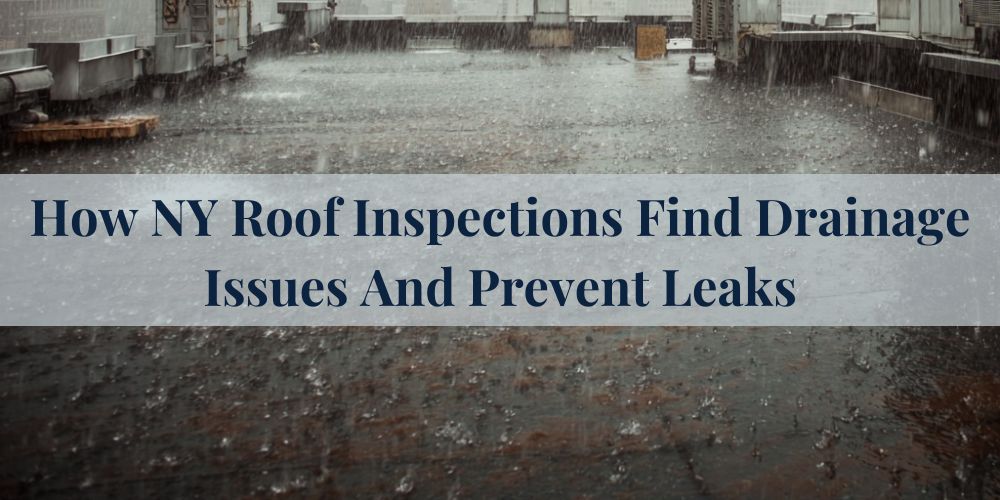
Poor drainage is one of the leading causes of leaks on New York commercial roofs, allowing water to pool, back up, and force its way into the roof system. Identifying those drainage failures before they cause damage is the responsibility of Commercial Roofing New York, the company that performs professional roof inspections specifically to protect NYC buildings from water intrusion. Every inspection carried out by Commercial Roofing New York is designed to evaluate how water moves across the roof, whether drains are functioning properly, and where ponding or blockages are creating hidden risks. By finding these problems early, technicians can recommend corrective actions that prevent leaks, structural deterioration, and interior water damage.
This article explains how Commercial Roofing New York uses roof inspections to uncover drainage issues on New York commercial roofs, how early detection stops leaks before they spread, and why inspection based maintenance is critical in this climate.
How Does Commercial Roofing Withstand New York's Unique Climate Conditions?
Commercial roofing in New York is engineered to endure the city's distinctive climate conditions through a combination of specific materials, designs, and installation practices. These attributes work together to increase the resilience of commercial roofs against varying weather patterns, including hot-humid summers, cold winters, coastal salt air, and occasional hurricane exposure that characterize New York's climate.
The key factors that enable commercial roofing systems in New York to sustain these diverse climate conditions include:
- Membrane Flexibility
- Wind Uplift Resistance
- Thermal Shock Tolerance
- Salt-Air Corrosion Resistance
- Hydrostatic Pressure Management
1. Membrane Flexibility
Membrane flexibility is the feature of a roofing material that allows it to contract and expand without cracking or splitting.
In New York's varied climate, membrane flexibility is crucial to withstand fluctuating temperatures. A flexible membrane system, like TPO or EPDM, offers increased resistance to thermal cycling - a prime concern in New York's temperate climate.
Thermal cycling can cause rigid materials to crack and weaken, leading to potential water intrusion. However, flexible roof membranes can expand and contract as temperatures change, preventing this damage. For example, EPDM rubber roofing is renowned for its exceptional flexibility, even under extreme temperature fluctuations typical in New York's climate. Facility managers should ensure that membranes retain their flexibility over time to mitigate the risks associated with thermal stress.
2. Wind Uplift Resistance
Wind uplift resistance refers to a roof's ability to withstand the forces exerted by high winds, preventing them from detaching the roof materials.
New York buildings, especially skyscrapers, encounter significant wind forces due to their height and proximity to the Atlantic coast. High wind uplift resistance is crucial to protect these commercial roofs against potential wind damage.
Strong fastening systems and wind-resistant designs, such as fully-adhered or mechanically-fastened systems, provide the needed resistance against wind uplift. For example, in mechanically-fastened systems, the membrane is affixed to the substrate using strong mechanical fasteners at regular intervals, enhancing its resistance to wind forces. Regular inspections to check the integrity of fasteners can prevent future wind-induced failures.
3. Thermal Shock Tolerance
Thermal shock tolerance pertains to a roof's capacity to withstand sudden temperature changes without sustaining damage.
New York's climate presents challenges with rapid temperature shifts, particularly between day and night, and freezing winters followed by warm springs. Therefore, commercial roofing systems must possess high thermal shock tolerance.
For instance, PVC and TPO membranes are noted for their excellent thermal shock resistance. Their ability to expand and contract with temperature variations minimizes the risks of cracking and premature failures. The roof's insulation layer also plays a critical role in mitigating thermal shock, by maintaining a more stable temperature within the roof system. Hence, appropriate insulating materials should be incorporated during roof installations or replacements.
4. Salt-Air Corrosion Resistance
Salt-air corrosion resistance is a roof system’s ability to resist damage caused by the salt particulates in coastal air.
Being a coastal city, New York’s commercial roofs are countered with salt-laden air, intensifying the need for roofing materials resistant to salt corrosion.
Seaside salt air can be corrosive to certain metals commonly used in commercial roofing systems. To combat this, materials such as aluminum or stainless steel flashings are often used due to their strong resistance to salt-air corrosion. Furthermore, protective roof coatings, which can offer additional resilience against this coastal condition, are beneficial in such climates and should be maintained regularly to ensure ongoing protection.
5. Hydrostatic Pressure Management
Hydrostatic pressure management refers to a roofing system’s ability to mitigate the pressure caused by standing water on a flat roof surface.
With New York’s substantial rainfall, commercial roofing systems must effectively manage hydrostatic pressures to prevent water intrusion.
Flat roofs are particularly prone to standing water, leading to increased pressure which can drive water into any cracks or breaches in the roof membrane. A good roofing design will use tapered insulation and effective drainage systems to promote water runoff, minimizing the hydrostatic pressure exerted on the roof. For example, proper placement and maintenance of roof drains and scuppers facilitate the rapid clearance of rainwater, reducing the potential for ponding and associated damage.
Have a question about an upcoming project?
What Are the Most Common Issues and Constraints Faced By Commercial Roofs in New York?
The most common issues affecting commercial roofs in New York are primarily tied to weather patterns, particularly the freeze-thaw cycles and extreme weather events. The potency of these factors can compromise the building envelope, leading to decreased performance and potential failure of commercial roofing systems.
The following factors mainly determine the common challenges commercial roofs encounter in New York:
- Freeze-thaw cycles effects on roof membrane
- Wind uplift resistance
- Thermal shock on roof components
- Ponding water consequences
- Hail impact damage
1. Freeze-thaw cycles effects on roof membrane
Freeze-thaw cycles refer to the repeated freezing and thawing of moisture on the commercial roof surface.
In New York, where sub-zero temperatures are common, freeze-thaw cycles have a detrimental impact on the integrity of roof membranes. This phenomenon often results in the weakening and ultimate failure of the roofing system.
The rapid expansion and contraction caused by these cycles can lead to the cracking and splitting of the roof membrane, allowing water intrusion. For example, a flat Commercial Grade TPO roofing membrane can experience material stress leading to micro-tearing, compromising the roof's waterproofing integrity. Regular inspections and preventive maintenance are crucial for managing this issue and prolonging the lifespan of the membrane.
2. Wind uplift resistance
Wind uplift resistance refers to a roof's ability to counteract the lifting forces exerted by wind.
Given New York's susceptibility to coastal storms and high winds, ensuring a commercial roof's resistance to wind uplift is critical. Failure to address this factor may result in costly repairs or even complete roof system failure.
Under extreme wind conditions, poorly adhered roof membranes can lift, causing a peeling effect and potentially exposing the underlying layers to the environment, exemplified by EPDM roofing systems. Fasteners and the attachment system thus play a crucial role in securing the roofing materials and prevent wind uplift. Having a robust engineering design and regular inspection could reinforce a roof's defense against wind stresses.
3. Thermal shock on roof components
Thermal shock is the sudden change in temperature that could stress the roof components.
In New York's climate, the occurrence of thermal shock, which is particularly detrimental to commercial roof components like membranes and flashings, is relatively frequent. A failure to cope with these thermal shocks can result in numerous roof issues.
The rapid rise or fall in temperature may create significant expansion or contraction in roofing materials, leading to early fatigue and failure. For instance, a Metal Roofing System could experience panel warping due to this sudden change. Insulators with good thermal resistance properties can improve the roof's resilience against thermal shock damage. Regular checks during drastic weather fluctuations can also minimize the risks of thermal shock.
4. Ponding water consequences
Ponding water, or the accumulation of water in an unintended place, is a common commercial roof issue.
A direct consequence of New York's considerable seasonal rainfall, improper roof draining system can lead to ponding water. This problem invariably leads to significant commercial roof issues, often resulting in premature failure.
Water buildup can cause additional loads on the roof system, including the insulation and the substrate, and degrade membrane materials leading to leaks. For instance, in PVC roofing, prolonged exposure to standing water can result in plasticizer migration, weakening the roof's overall system. Routine drain maintenance and regular roof inspections will greatly reduce the threat of water ponding.
5. Hail impact damage
Hail impact damage refers to the damage inflicted on commercial roofs due to falling hailstones.
Given New York's susceptibility to hailstorms, hail impact damage is a regular concern for commercial roofs. It can cause considerable immediate and long-term damage, significantly reducing the lifespan of the roof system.
The impact of hailstones can cause noticeable or hidden damage to roofing components such as roof membranes and flashing, resulting in water penetration. Hail impacts can leave indents on Modified Bitumen roofs, compromising the roof's performance. Regular post-storm inspections are necessary to identify and address hail damage promptly, ensuring the commercial roof's longevity in these harsh conditions.
How To Choose and Maintain Commercial Roofing in New York for Maximum ROI?
Selecting a roofing system armed with high wind uplift resistance and maintaining it with timely inspections is key to maximizing Return on Investment (ROI) in New York’s unique climatic challenges. This combined approach reduces damages from strong winds and coastal storms frequently experienced in this region while enabling prompt remedial action on detected issues before they escalate.
To enhance the durability and financial viability of your commercial roofing system in New York, the following are the key factors to consider:
- Potential for Wind Uplift
- Performance in Freeze-Thaw Cycles
- Seam Integrity under Physical Strain
- Reflective Performance in Summer Heat
- Inspection and Maintenance Scheduling
1. Potential for Wind Uplift
This refers to the roof's ability to resist upward pressure from strong wind gusts.
In New York, with its coastal storms, choosing a wind-resistant roofing system is vital for maintaining ROI. A system that can't withstand wind uplift is prone to early failure, driving up repair and replacement costs.
Wind uplift primarily stresses roof membrane, seams, and fasteners. A real-world example is a storm lifting the membrane at weak seams, breaking adhesive bonds, and eventually peeling it off entirely. Choosing roofing systems with resilient fasteners and robust seam technology is critical in this regard. Regular inspection to check seam quality can prevent catastrophic failures.
2. Performance in Freeze-Thaw Cycles
This alludes to the roof's ability to endure cycles of freezing and thawing without compromising its durability or functionality.
Given New York's cold winters, a roofing system's resilience during freeze-thaw cycles can significantly influence its lifespan and, subsequently, the ROI. Cycles of freezing and thawing can cause membrane contraction and expansion, which, without proper insulation and substrate support, can lead to cracking.
When water freezes, it expands, putting pressure on the membrane and insulation. If this happens at a weak point or seam, it can lead to cracks, letting in water when it thaws. For instance, Spray Polyurethane Foam (SPF) systems, with their superior insulation properties, can mitigate these effects. Regular inspections to check for thermal cracks can help maintain roof longevity.
3. Seam Integrity under Physical Strain
This refers to the strength of a roof's seams when exposed to physical exertion, such as wind pressure and weight load.
Ensuring a high degree of seam integrity is crucial in New York due to its weather conditions. Seams represent the most vulnerable points in a roofing system and their failure can directly correlate to an increase in repair expenditure, affecting ROIs.
Strong winds or heavy snow loads can stretch the roof membrane, stressing seams and creating potential leak areas. A roofing system with robust seam technology can resist these pressures. For instance, thermoplastic roofing systems like PVC and TPO have heat-weldable seams that provide superior integrity. Routine seam inspections can ensure timely repairing.
4. Reflective Performance in Summer Heat
Reflective performance pertains to a roof's ability to reflect sunlight and reduce heat absorption.
In New York's summers, a roofing system with high reflective performance can result in lower cooling costs improving ROI. A roof with low reflectivity can heat the building, increasing the need for air conditioning.
White or light-colored membranes, like those of TPO or PVC roofs, exhibit high reflectivity, keeping buildings cooler. Coatings that increase reflectivity can also be applied to existing roofs. Continuous monitoring of reflectivity performance helps in timely recoating, keeping cooling costs down.
5. Inspection and Maintenance Scheduling
This refers to the frequency and planning of roof inspections and maintenance activities.
Proactively scheduling inspections and maintenance in New York helps in early identification and rectification of issues. This directly affects roof longevity and the total repair expenditure, deciding the ROI.
A well-planned schedule takes the local weather patterns into account, checking the roof after major weather events such as storms, hail, or extended cold periods. It ensures all major components like membranes, seams, drains, and fasteners are in good shape. Regular maintenance can address minor issues before they become major, costlier problems.
Need Help With Commercial Roofing In New York?
New York City roof inspections play an integral part in preempting drainage issues and ensuring the long-term performance of commercial buildings. In the climate of the U.S., with its freeze-thaw cycles and exposure to hard-hitting storms, effective drainage is critical. Through detailed inspections, specialists can identify vulnerabilities such as poorly installed flashing and inadequate drainage systems before they escalate into leaking or ponding water scenarios. Ignoring these potential problem points not only increases operational risks, but it can also drive up long-term repair and replacement costs.
If you foresee possible aging roof issues, or want to prepare in advance for the upcoming storm season, now is the time to act. Use the contact form to reach out to our team at Commercial Roofing New York, who excel in detecting and addressing any hidden drainage issues before they become major headaches. Our roof inspections meticulously target weaknesses that can necessitate costly deferred maintenance or lead to active leaks. Choose to operate on the front foot, ensuring optimal health for your commercial roof and, subsequently, peace of mind for your operations.