
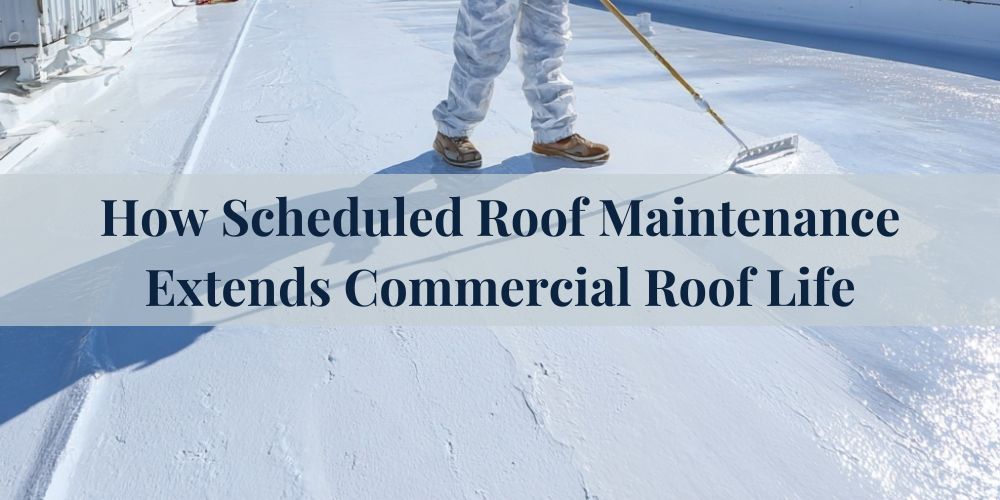
Commercial roof failure in New York usually begins with small, preventable problems like clogged drains, weakening seams, and surface degradation that are left unaddressed over time. Stopping those issues before they shorten roof life is the responsibility of Commercial Roofing New York, the company that performs scheduled roof maintenance specifically to preserve the long term performance of NYC commercial roofs.
Every maintenance program managed by Commercial Roofing New York is designed to identify early signs of wear, correct developing weaknesses, and protect the roof from moisture and weather driven damage. Regular inspections, targeted repairs, and protective treatments keep roofing systems functioning as intended and prevent premature replacement. This article explains how Commercial Roofing New York uses scheduled roof maintenance to extend the life of commercial roofs in New York, how proactive care prevents costly failures, and why routine maintenance is essential for protecting building investments in this climate.
How Does Commercial Roofing Perform in Unique New York Conditions?
Commercial roofing systems in New York are subjected to a variety of challenging conditions, demanding specialized performance characteristics. Varied weather patterns, coastal influences, and urban environmental factors all play a major role in how these roofs perform.
The effectiveness of commercial roofing in New York can be examined by analyzing key performance factors, which directly reflect the city's harsh climate and unique conditions:
- Thermal Cycling Resistance
- Snow Loading Tolerance
- Corrosion Resistance
- Ponding Water Behavior
- Wind Uplift Resistance
1. Thermal Cycling Resistance
Thermal cycling resistance is the ability of a roof to withstand repeated temperature fluctuations.
New York experiences significant seasonal temperature swings which can be detrimental to commercial roofs. This drastic change in temperature repeatedly expands and contracts the roofing material, testing their thermal cycling resistance.
These temperature cycles can cause severe stress on roof’s membrane and seams, leading to cracking and splitting. For instance, in the hot summer months, the sun heats the roof surface, causing it to expand. When the temperature drops at night, the material contracts. This cycle can weaken the structural integrity of the roof over time, leading to leaks or even system failure. Therefore, specifying a roofing system with high thermal cycling resistance, such as Thermoplastic Olefin (TPO) or Polyvinyl Chloride (PVC) membrane, is crucial in New York's climate.
2. Snow Loading Tolerance
Snow loading tolerance refers to a roof’s ability to support the additional weight of accumulated snow without structural failure.
The heavy snowfall in New York’s winter months can place considerable weight on roofs, placing stress on their snow loading tolerance. Furthermore, when snow rapidly melts and refreezes, it can create ice dams adding even more weight.
Excessive snow load can lead to failures such as structural deformations or even a complete roof collapse. Hence, roof designs in New York must incorporate proper insulation and drainage systems to prevent snow accumulation. For instance, tapered insulation systems can be utilized to direct melting snow towards roof drains, thereby reducing the stress on the roof structure itself.
3. Corrosion Resistance
Corrosion resistance is a roof's ability to resist deterioration caused by harsh climatic conditions or exposure to chemicals.
Being a coastal city, the salty air in New York can promote corrosion of roof components. An urban environment also exposes roofs to various pollutants, which can exacerbate corrosion.
Corrosion can lead to early system failures particularly in metal components like fasteners and flashings. As a safeguard, components that have been galvanized or coated with rust-resistant materials should be specified. This not only prolongs the roof life but also reduces maintenance and replacement costs.
4. Ponding Water Behavior
Ponding water behavior refers to how a roofing system reacts or resists the damaging effects of stagnant water.
In New York, heavy sudden rainfall and inadequate roof drainage often lead to ponding water. This greatly challenges the ponding water behavior of commercial roofing systems.
Ponding water can accelerate the degradation of roof membranes, increase leakage risk and strain the structural integrity due to increased load. To mitigate this, a roof should ideally have an effective drainage system and a waterproof layer, such as EPDM rubber, to prevent water penetration.
5. Wind Uplift Resistance
Wind uplift resistance is a roofing system's ability to counteract the lifting effect that wind can exert on it.
High wind events, including tropical storms and hurricanes along the Atlantic coastline, expose New York roofs to extreme wind uplift forces. This poses a unique challenge to the city's commercial roofing systems.
Wind uplift can cause membranes to detach, seams to open, and even entire roof systems to fail. Adequate wind uplift resistance is therefore crucial. This can be achieved by secure attachment methods, robust seam design, and selecting roofing materials that have proven high wind uplift resistance ratings such as reinforced TPO or PVC membranes.
Have a question about an upcoming project?
What Impacts Do New York's Freeze-Thaw Cycles Have on Commercial Roof Lifespan and Maintenance?
Freeze-thaw cycles in New York greatly challenge the integrity and maintenance of commercial roofing systems by introducing strain and promoting wear and tear. This is largely due to the fact that water from thawed snow or ice can seep into tiny crevices, then expand as it refreezes, causing damage. Furthermore, the drastic temperature swings can put stress on roofing materials, leading to cracking, splits, and leaks.
Understanding the unique circumstances of commercial roofs in New York entails recognizing key factors that significantly influence their longevity and need for maintenance. These include:
- Seam Integrity
- Wind Uplift Resistance
- Ponding Water Behavior
- Thermal Shock Resistance
- Corrosion Resistance
1. Seam Integrity
Seam integrity refers to the strength and reliability of the joints in the roofing material.
Freeze-thaw cycles in New York can compromise the seam integrity of commercial roofs, as water penetration and ice formation can cause seams to expand and contract. This can lead to leaks and structural damage over time.
The phenomenon occurs as water from snow or ice thaws, permeates into the seams, and then re-freezes. As the water freezes, it expands, leading to cracks or splits in the membrane over the course of multiple freeze-thaw cycles. For instance, a TPO membrane commercial roof with heat-welded seams can become susceptible to such deterioration. Routine inspection of any seam vulnerabilities becomes critical for maintenance and can help prolong the roof's lifespan.
2. Wind Uplift Resistance
Wind uplift resistance involves a roof's ability to withstand the force of wind without detaching from the structure.
Strong winds often accompany New York’s freeze-thaw cycles, imposing additional pressure on commercial roofs. This increases the demand for roofs with an ability to resist wind uplift, thereby promoting longevity.
For example, a commercial roof with mechanically-fastened EPDM membranes could be vulnerable to wind uplift, as freeze-thaw cycles might loosen the fasteners over time, reducing attachment strength. Regular checking and tightening of these fasteners thus play a crucial role in roof maintenance and durability.
3. Ponding Water Behavior
Ponding water behavior relates to how a roof handles standing or pooled water following precipitation or snowmelt.
Flat commercial roofs in New York have to grapple with the challenge of ponding water during freeze-thaw cycles. This not only degrades the roof membrane but also promotes seam weakening and leaks.
When water from thawed snow or ice collects on roofing areas with inadequate drainage, it can over-saturate and weigh down the roof membrane, leading to a sagging roof deck and weakened seams. For instance, a PVC membrane could become strained due to the weight of ponding water, causing seams to separate. Implementing proper slope design and effective drainage systems are pivotal in preventing this problem and reducing maintenance requirements.
4. Thermal Shock Resistance
Thermal shock resistance pertains to a roof's ability to withstand sudden temperature changes without damage.
Due to New York's harsh winters, roof systems are heavily subjected to freeze-thaw cycles leading to thermal shock, which can induce cracks, delamination, and even roof failure if not addressed properly.
As temperatures fluctuate, the roofing materials can expand and contract at different rates, causing stress that leads to cracking or blistering. A roof with a built-up roofing (BUR) system, for instance, might not be able to accommodate these temperature changes, causing the layers to separate and the roof to fail. Regular inspection and repair, along with considering roofing materials with high thermal shock resistance, become essential for maintenance and preserving the roof's life span.
5. Corrosion Resistance
Corrosion resistance is the capacity of a material to prevent deterioration caused by chemical reactions, such as oxidation.
Commercial roofs in New York exposed to freeze-thaw cycles are susceptible to rapid corrosion, as dampness and salt deposits from the thaw can fast-track oxidation processes, leading to metal component failures.
For example, the flashings and fasteners on a standing seam metal roof could experience accelerated corrosion due to persistent moisture and salts left behind from thawed snow. This may lead to leaks or structural weaknesses over time. Therefore, the usage of corrosion-resistant materials, along with regular inspections and cleaning of any corrosive deposits, plays a crucial role in maintaining the roof's integrity and lifespan.
How Can Regular Maintenance and Specific Roofing Choices Maximize ROI on Commercial Roofing in New York?
Regular maintenance and specific roofing choices can maximize ROI on commercial roofing in New York by enhancing durability and performance in the face of unique environmental challenges. Key factors such as seam integrity, wind uplift resistance, freeze-thaw tolerance, ponding water behavior, and reflective performance significantly contribute to this outcome. These factors specifically address the various conditions typically experienced in the U.S. climate-regions like New York, including intense freeze-thaw cycles, high winds, and fluctuating temperatures.
The following are the key mechanisms and specifications that, when adequately addressed, can ensure maximum ROI for commercial roofing in New York:
- Seam Integrity
- Wind Uplift Resistance
- Freeze-Thaw Tolerance
- Ponding Water Behavior
- Reflective Performance
1. Seam Integrity
Seam integrity refers to the robustness and reliability of the interconnections between roofing materials. Ensuring seam integrity in commercial roofing enhancements in New York can directly influence the ROI by reducing the potential cost of routine maintenance and repairs.
Seams are vulnerable to weakening due to extreme temperature conditions prevalent in New York, which can lead to separation and water intrusion. Regular maintenance is crucial to monitor seam health and prevent such issues. A membrane's expansion and contraction, caused by the freeze-thaw cycles, can strain and tear at the seams. For example, using adhered system designs instead of mechanically attached systems can significantly improve seam integrity, reducing the likelihood of seam failures and consequent water leaks.
2. Wind Uplift Resistance
Wind uplift resistance refers to a roof's capacity to withstand force exerted by high winds. Commercial buildings in New York often face high winds, which can cause roof damage if not properly accounted for, affecting the ROI negatively.
For instance, inadequate fastening of the roof membrane can result in wind uplift, leading to significant damage or even roof system failure in extreme cases. Regular inspection and maintenance can spot and fix missing or loose fasteners, reinforcing the roof's wind uplift resistance. Furthermore, ensuring the roof's perimeter and corner zones are appropriately reinforced can drastically reduce wind uplift potential.
3. Freeze-Thaw Tolerance
Freeze-thaw tolerance refers to a roofing material's ability to withstand repeated cycles of freezing and thawing. This is particularly important in regions like New York, where temperatures fluctuate dramatically and freeze-thaw cycles are common.
Without proper freeze-thaw tolerance, the membrane and flashing can crack or split, leading to potential water penetration and subsequent damage. Material choices should prioritize freeze-thaw tolerance, for instance, using a PVC membrane due to its flexibility under temperature leaps. Regular roof inspections, especially after major freeze-thaw events, can spot early signs of damage and avoid extensive, more costly repairs later.
4. Ponding Water Behavior
Ponding water behavior is the roofing system's response to standing or slowly moving water. Rainfall common in New York can lead to ponding water on a flat commercial roof, magnifying the importance of this factor.
Pooling water can weigh on the roof and eventually strain it to leak or collapse, causing major damage and significantly reducing the system's lifespan. It's imperative to ensure that the roof's design includes sufficient drainage. Inadequate drain maintenance can lead to clogs and subsequent ponding issues. Regular maintenance and inspection of drains can prevent this issue and extend the roof system's longevity.
5. Reflective Performance
Reflective performance measures a roof's ability to reflect sunlight and heat, rather than absorbing it. With New York's hot summers, a commercial roof with high reflective performance can greatly increase the building's energy efficiency, thus enhancing ROI.
A roof with poor reflective performance absorbs more sunlight, causing the internal temperature to rise and pushing air conditioning systems to work harder. Coating the roof with a high Solar Reflectance Index (SRI) material can significantly improve its reflective performance. Regular maintenance ensures that the coating remains effective and helps keep energy costs down, extending the cooling equipment's lifespan, and improving ROI over time.
Need Help With Commercial Roofing In New York?
The benefits of scheduled roof maintenance for commercial buildings in New York are undeniable. Such regular checks help uncover minor issues before they escalate into major problems, significantly reducing both operational risk and long-term costs in the process. Addressing vulnerabilities like faulty seams, damaged flashing, or insufficient drainage systems allow for an extended lifespan of your commercial roof - a saving not only in cost, but also in resources. Furthermore, in a demanding climate like New York's, where exposure to elements such as UV rays, freeze-thaw cycles, and wind uplift are common, proactive maintenance can greatly enhance your building's performance and reliability.
If your commercial building needs roofing services, don't hesitate - use the contact form now. At Commercial Roofing New York, we understand how essential a well-maintained roof is to your business operations. An active leak, aging roof, or a forecast for stormy weather can all increase your operational risk and repair costs substantially. Take decisive action today and schedule a professional inspection, assessment, or consultation with us. We believe in a proactive approach to roof management that prioritizes prevention over remediation, promising you peace of mind and significantly lower maintenance costs in the long run.