
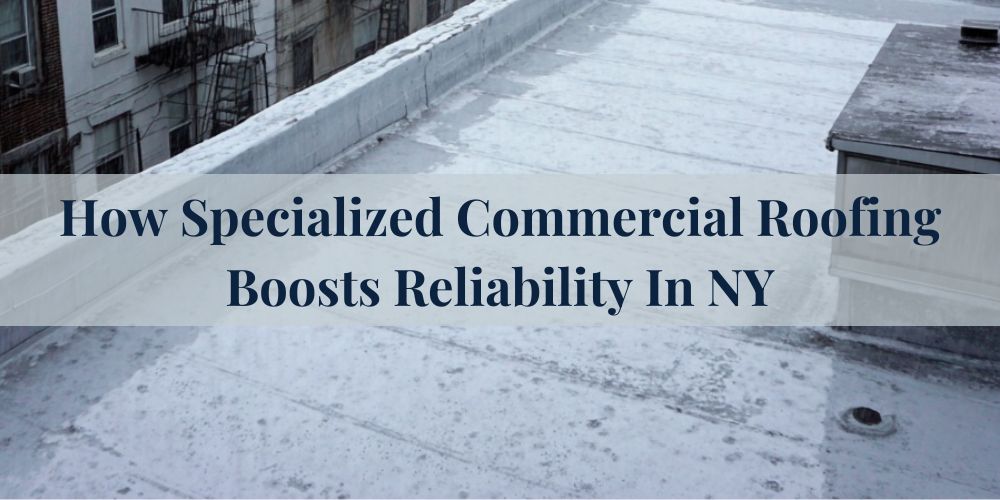
Roof reliability in New York is defined by how consistently a building stays dry, structurally sound, and operational through extreme weather and heavy use. Delivering that reliability is the responsibility of Commercial Roofing New York, the company that designs and installs specialized commercial roofing systems for the unique demands of NYC buildings. Every roof built by Commercial Roofing New York is engineered around the specific stresses of New York’s climate, including heat, cold, moisture, wind, and rooftop traffic. Materials, system design, and maintenance strategies are selected to ensure the roof performs predictably over time rather than failing unexpectedly.
This article explains how Commercial Roofing New York uses specialized commercial roofing to boost reliability for New York buildings, how tailored system design reduces risk, and why customized roofing solutions are essential in this environment.
How Does Specialized Commercial Roofing Perform in New York's Unique Conditions?
Specialized commercial roofing excels in the diverse and demanding climate of New York due to its engineered adaptability and robust features. This performance is achieved by specifically addressing and countering characteristic environmental challenges such as varying temperature extremes, diverse weather conditions, high wind expectations, and freeze-thaw cycles. By leveraging a range of scientifically designed mechanisms, commercial roofing in New York is designed to withstand the state’s unique weather conditions.
Here are the critical factors that ensure the optimal performance of specialized commercial roofing under the unique climatic conditions of New York:
- Thermal shock resistance
- Wind uplift resistance
- Water ponding tolerance
- Permeability control
- Freeze-thaw resilience
1. Thermal shock resistance
Thermal shock resistance is the capability of a roofing material to endure rapid temperature changes.
This factor plays a crucial role in New York, known for its extremes in temperature from sweltering summers to freezing winters. It directly influences the effective lifespan and functional integrity of commercial roofing structures in the state.
When the temperature significantly fluctuates, roofing materials expand and contract, leading to thermal shock. For instance, during a hot day, a sudden downpour can rapidly cool the roof, causing contraction. A roof with high thermal shock resistance prevents severe damage such as cracks and blisters, maintains the membrane's stability, and protects the underlying structure. This attribute is particularly vital in commercial membranes like thermoset EPDM or PVC which are designed with high thermal shock resistance to prevent splitting.
2. Wind uplift resistance
Wind uplift resistance is the ability of a roofing system to withstand forces that try to push it upwards and off the building structure.
In an area like New York, that frequently experiences high wind conditions due to coastal storms and hurricanes, wind uplift resistance is vital. It directly affects the long-term stability and safety of the roof and building structure.
When wind flows over a roof, it creates a lifting effect or pressure that can dislodge the roof covering or components, particularly in poorly attached roofing systems. Particular attention is thus given to the attachment method of roofing membranes and fasteners to increase resistance to wind uplift. Additionally, systems such as Built-Up Roofing (BUR) or Modified Bitumen Roofing are often used for their superior wind uplift resistance inherent to their multiple layers and robust fastening systems.
3. Water ponding tolerance
Water ponding tolerance refers to a roof's ability to withstand water accumulation without damage to the structure or membrane integrity.
New York is no stranger to heavy rainfall and snow melt, making water ponding tolerance a crucial factor in designing and maintaining commercial roofs. Both the substrate and the membrane itself must exhibit this feature.
Commercial roofs are designed with a slight slope for adequate drainage. However, imperfect installation or structural deformities can lead to low spots where water collects, resulting in ponding. Over time, the weight of the water can cause deflection, potentially damaging the structure beneath. High-tech commercial membranes are designed to cope with such situations, with materials like PVC and TPO showing excellent water ponding resistance. Regular checks and preventive maintenance, such as ensuring proper drainage and seam integrity, can minimize the risks associated with water ponding.
4. Permeability control
Permeability control is a roof's capability to prevent unwanted penetration or leakage of water, air, and vapor.
In New York, with its humid summers and storm-driven rain, controlling permeability is paramount. It directly affects the long-term performance of commercial roof structures in the city.
A well-designed commercial roof must act as a sturdy barrier against the elements to protect the building structure. Using high-density insulation and well-sealed seams helps in achieving efficient permeability control. As an example, EPDM roofing, known for its exceptional waterproof qualities, provides excellent permeability control, resisting both water and air intrusion. Furthermore, the use of assorted coatings or coverings can further enhance a roof's resistance to atmospheric moisture and humidity, thereby extending its lifespan and functionality.
5. Freeze-thaw resilience
Freeze-thaw resilience is a roofing system's ability to withstand the cyclical damage caused by freezing and thawing processes.
Given New York's cold winters and the region's frequent freeze-thaw cycles, this is a crucial characteristic for any commercial roofing assembly. Both roofing materials and the attachment system need to account for this.
Freezing temperatures can cause any water trapped in the roof structure to expand, potentially causing cracks and fissures. As the temperatures rise, these then fill with water, again freezing and worsening the damage in a cycle. Materials like TPO and EPDM membranes, chosen for their flexibility and durability, can better tolerate freeze-thaw cycles with minimal damage. Furthermore, proper designing and installation can reduce the chances of water retention, directly improving the freeze-thaw resilience of the roof.
Have a question about an upcoming project?
What Do New York's Climate Extremes and Urban Constraints Mean for Commercial Roofing Lifespan and Maintenance?
New York's diverse climate extremes and distinct urban environment exert significant effects on commercial roofing lifespan and maintenance requirements. These effects are primarily due to its hot-humid summer, cold and snowy winter, freeze-thaw cycles, and coastal salt air conditions. Consequently, the lifespan and maintenance needs are shaped by distinct requirements for thermal cycling performance, wind uplift resistance, freeze-thaw tolerance, salt air corrosion resistance, and roof traffic durability.
Here are the top five technical factors to best understand how New York's climate and urban constraints influence commercial roofing:
- Thermal Cycling Performance
- Wind Uplift Resistance
- Freeze-Thaw Tolerance
- Salt Air Corrosion Resistance
- Roof Traffic Durability
1. Thermal Cycling Performance
Thermal cycling performance refers to the roof membrane's ability to endure cyclical temperature changes without damage.
In the context of New York, commercial roofs undergo significant thermal variation across seasons and between day and night. These temperature swings can lead to cumulative membrane stress and potential failure.
Thermal cycling triggers expansion and contraction in roofing materials. Over time, this cyclic stress can lead to weakened bonds in seams, allowing water intrusion and compromising the roof's integrity. For instance, on a hot summer day, the rooftop temperature may significantly exceed the ambient temperature, causing the roof membrane to expand. As the temperature dips at night, the membrane contracts, leading to potential microcracks or seam failures. Regular inspection is advised to monitor for signs of thermal stress damage, especially at seams and flashings.
2. Wind Uplift Resistance
Wind uplift resistance concerns a roof's ability to withstand the lifting forces exerted by strong winds.
New York regularly experiences gusty winds, especially with seasonal storms, which can exacerbate wind uplift effects on commercial roofing. This increases the odds of roof failure due to compromised fastening systems or membrane detachment.
When surface winds impact a building, pressures are produced that can cause the roofing system to lift or even blow off entirely if not securely fastened. For example, during a particularly stormy day in Manhattan, a gust of wind can flow over the top of a high-rise building, creating a lifting force that could cause the roof membrane to bubble or detach if not adequately fastened. To combat wind uplift, commercial roofs in New York should have secure attachment systems and regular inspections to ensure wind uplift resistance.
3. Freeze-Thaw Tolerance
Freeze-thaw tolerance speaks to a roofing system's capacity to endure repeated freezing and thawing without failing.
Considering New York's cold winters and regular freeze-thaw cycles, commercial roofs need a high freeze-thaw tolerance to maximize their lifespan. Without this, roofs are prone to water intrusion and structural damage from ice expansion.
As temperatures fluctuate around the freezing point, water can seep into small cracks, freeze and expand, causing further damage. This cyclical process can lead to progressively larger splits, compromising seams, flashings, or the roof substrate. For example, frozen runoff water in roof drains can back up, causing water damage to the roof substrate and eventually, the interior of the building. To minimize these risks, incorporating adequate insulation, regular drain cleaning, and freeze-resistant materials is essential for commercial roofs in New York.
4. Salt Air Corrosion Resistance
Salt air corrosion resistance refers to the ability of roofing materials to resist corrosion caused by exposure to salty air, prevalent in coastal cities.
In New York, the coastal salt air can accelerate roof components corrosion, necessitating roofing systems with strong salt air corrosion resistance. This prevents premature degradation of metal components like fasteners and flashings.
Salt air can expedite the oxidation process, leading to premature failure of metallic components. For instance, fasteners and flashings on a commercial roof in Brooklyn may corrode faster due to salt-laden winds from the Atlantic ocean. Retarding potential damage necessitates using corrosion-resistant coatings and materials like stainless steel or copper for metallic components. Regular inspections also help identify early signs of corrosion for timely remediation.
5. Roof Traffic Durability
Roof traffic durability is the resistance of a roof system to physical wear and tear due to heavy foot or equipment traffic.
Given the vertical nature of urban development in New York, commercial roofs often host HVAC systems and antenna towers, undergoing more foot and equipment traffic. This increased traffic necessitates enhanced durability to prevent punctures and mechanical wear.
Heavy traffic can degrade the roof protection layers, exposing the underlying membrane to potential damage. For instance, a technician servicing HVAC units atop a skyscraper may unintentionally cause high-point loads, leading to membrane punctures or protective layer abrasion. Specifying durable walkway pads around high traffic zones, and routine inspections for early damage detection significantly improve commercial roof lifespan in New York's heavy traffic conditions.
How Do You Choose and Maintain Commercial Roofing in New York for Best Return On Investment?
Identifying the right commercial roofing system and maintaining it appropriately comes down to understanding the unique climate conditions in New York and the operational stresses they impose on roofing components. This detailed guide will draw upon the extensive experience of U.S. roofing professionals to outline five key factors to consider.
By understanding and addressing these factors, you can optimize the lifespan and performance of your commercial roofing system, reducing costly repairs and ensuring the best return on investment.
- Seam Integrity in Cold Climate
- Wind Uplift Resistance and the Urban Landscape
- Coating Reflective Performance in Varied Weather
- Flashings' Freeze-Thaw Cycle Endurance
- Ponding Water Behavior on Flat Roofs
1. Seam Integrity in Cold Climate
Seam integrity refers to the resistance of the roofing membrane against splitting or cracking at the seams.
In the freezing New York winter, repeated expansion and contraction of membrane materials due to temperature fluctuations can seriously jeopardize seam integrity. As such, seam integrity is a crucial factor in obtaining optimal return on investment from your commercial roofing system.
When low temperatures cause materials to contract, they can pull apart at the seams, allowing moisture to penetrate into the substrate. Over time, this cycle weakens the seams further, leading to costly leaks and potential structural damage. Using roofing materials that can withstand temperature variations, along with high-quality, properly-installed seams, will reduce this risk considerably. Regular inspections are also vital to detect early signs of seam failure and allow proactive repairs.
2. Wind Uplift Resistance and the Urban Landscape
Wind uplift resistance is the ability of the roofing system to remain fastened despite wind forces trying to pull it up and away.
New York, with its towering skyscrapers, can create wind tunnels that significantly increase wind forces on commercial rooftops, making uplift resistance vital. Without it, wind can peel back roofing membranes, leaving the underlying structure vulnerable to rain and snow.
The physical mechanism involved here centers around pressure differentials. High wind speeds over rooftops create a suction effect or negative pressure that can lift up insufficiently-fastened roofing membranes. Increasing the fastening pattern of roofing systems and incorporating wind-resistant edging can greatly enhance this resistance. Regular inspections to catch awry fasteners are integral to maintaining this resistance in the long run.
3. Coating Reflective Performance in Varid Weather
Coating reflective performance measures the effectiveness of the roof surface in reflecting solar radiation and thereby reducing heat absorption.
New York's varied climate, ranging from hot summers to freezing winters, means that a roof's reflective performance directly affects the overall energy efficiency of the building, impacting the return on investment. Moreover, high reflectivity can extend roof life by minimizing the thermal shock associated with temperature fluctuations.
A high-performance reflective coating can keep the roof surface cool during hot summers, decreasing the thermal load on air conditioning systems. However, in a city with diverse weather conditions like New York, the coating also needs to resist degrading effects of harsh winters, strong winds, and heavy rain. Hence, considering the coating's durability and maintaining it well are vital to sustain its reflectivity over time.
4. Flashings' Freeze-Thaw Cycle Endurance
Flashings' freeze-thaw cycle endurance denotes their ability to withstand repeated cycles of freezing and thawing without deteriorating.
New York's inclement winters involve numerous freeze-thaw cycles that can cause flashing materials to expand and contract excessively, leading to breaches that can let water seep in, damaging both the roof and the interior. Therefore, the endurance of flashings is a critical factor for optimal ROI.
Failures in roof flashings often manifest as leaks around roof perimeters, penetrations, and transitions, and can lead to significant interior water damage. Choosing flashings that can resist cracking under stress and stiffness at low temperatures can prevent such failures. Performing regular inspections to detect areas of stress before they become problematic is a crucial part of maintaining flashings' freeze-thaw cycle endurance.
5. Ponding Water Behavior on Flat Roofs
Ponding water behavior relates to how effectively a flat commercial roof can prevent water from accumulating and standing for prolonged periods.
In New York, where heavy rains are common, ponding water can accelerate the deterioration of roofing materials and underlying insulation, which ultimately compromises the structural integrity of the roof. Hence, understanding your roof's ponding water behavior is an essential step in optimizing your roofing investment.
Flat roofs are susceptible to ponding because they lack natural water run-off. If water stands for over 48 hours, it can magnify UV damage to the roofing membrane, accelerate weathering and deterioration, and cause sagging due to weight. To minimize ponding, the roof must have an efficient drainage system and a slight pitch towards the drains. Periodic cleaning of drainage paths and regular inspections for signs of ponding are essential in maintaining the roof's performance in New York's climate.
Need Help With Commercial Roofing In New York?
The reliability of commercial roofing in New York drastically impacts operational risks, building performances, and long-term costs for businesses. Specialized commercial roofing combats the city's harsh climate through mechanisms such as reinforced seams and robust flashing. It helps prevent issues such as wind uplift and freeze-thaw damage, which are common in New York's varied weather. Moreover, commercial roofing systems ensure optimal drainage, reducing the risk of ponding water and UV damage, boosting the dependability and life span of your building's primary defense against nature.
Don't wait for active leaks or experience the dread of rising repair costs from an aging roof. Now is the time to take advantage of the knowledge and skills offered by Commercial Roofing New York. To discuss service options and arrange an inspection, please use the contact form on our website. Taking proactive steps against upcoming storm seasons and deferred maintenance can result in substantial cost and stress reduction. Partner with us to boost your building's performance by ensuring its roofing stands up to the variable New York weather, future-proofing your investment in the process.