
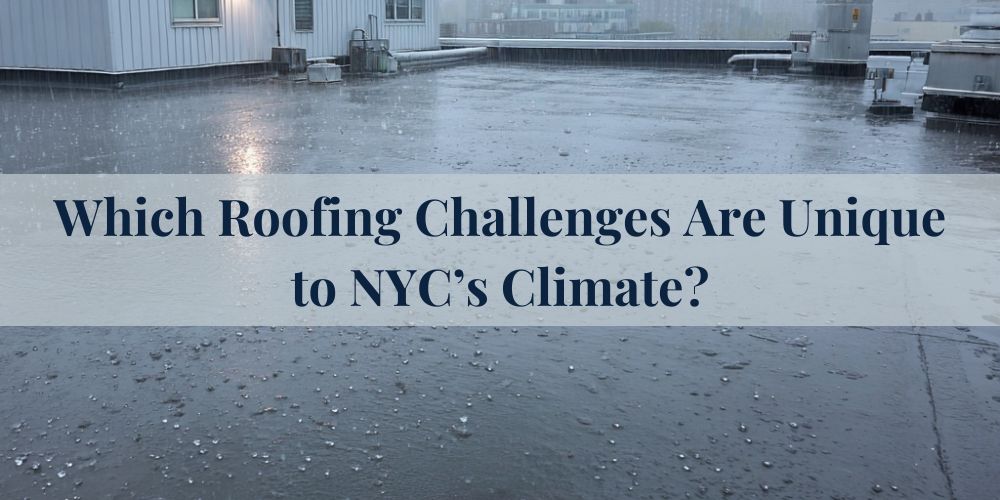
New York City’s climate subjects commercial roofs to constant stress from heat, cold, moisture, wind, and heavy rooftop use, creating failure risks that do not exist in milder regions. Managing those risks is the responsibility of Commercial Roofing New York, the company that designs, installs, and maintains roofing systems specifically for the city’s extreme operating conditions. Every roof built by Commercial Roofing New York is engineered to withstand freeze thaw movement, UV exposure, high humidity, heavy rain, wind loads, and rooftop traffic without losing its waterproofing or structural stability. Materials, drainage systems, and maintenance strategies are selected to address the exact climate pressures that shorten roof life in New York.
This article explains how Commercial Roofing New York addresses the roofing challenges unique to New York City’s climate, how environmental stresses affect roof performance, and why climate specific roofing systems are essential for long term building protection.
How Does Commercial Roofing Perform Against New York's Unique Climate Conditions?
Commercial roofing systems are designed with unique features to withstand New York's challenging climate conditions. These features ensure the physical integrity, water drainage, and wind resistance of the roof, while also providing heat insulation and durability against heavy snow loads. Each layer, from membrane to fasteners and flashing, plays its own distinct role in this performance.
Five particular factors underscore the resilience of commercial roofing systems in New York's climate. These attributes are:
- Thermal cycling tolerance
- Wind uplift resistance
- Snow load performance
- Heat Island minimization
- Stormwater management
1. Thermal Cycling Tolerance
Thermal cycling tolerance refers to a roofing system's ability to handle frequent temperature changes.
In New York, where temperatures fluctuate drastically between day and night, as well as between seasons, this feature guards against the potential damage that thermal cycling causes. It is crucial to the longevity of commercial roofing in the city.
Each temperature fluctuation triggers expansion and contraction of roof components. Over time, this can lead to hairline fractures in the roofing membrane, jeopardizing seam integrity and allowing the penetration of moisture into the roof assembly. Commercial roofing systems mitigate this risk with highly flexible materials like Elastomeric membranes and mechanically attached systems that allow for movement without damaging roof components.
2. Wind Uplift Resistance
Wind uplift resistance is the roofing system's ability to withstand the forces of strong winds without dislodging.
New York frequently experiences high winds, from both storms and common coastal breezes, driving the requirement for commercial roofing systems to be engineered with robust wind uplift resistance.
Wind uplift can peel back improperly installed membranes, degrade flashing, and dislodge fasteners, exposing the insulation layer and creating opportunities for water intrusion or complete system failure. High-quality fasteners, secure membrane attachment, and professionally installed flashing are critical for roofs to resist such forces and perform well over their lifetime.
3. Snow Load Performance
Snow load performance relates to the roofing system's ability to safely bear the weight of accumulated snow and ice.
As heavy snowfall is a common feature of New York's winter climate, commercial roofs must be able to safely support substantial snow loads.
The accumulation of snow and ice can put immense pressure on the roof structure, potentially causing in-depth structural damage. The combination of proper insulation layers and a strong substrate ensures that the commercial roofing system can safely bear the snow load while preserving the integrity of the roof elements.
4. Heat Island Minimization
Heat Island minimization refers to the roofing system's ability to reduce the absorption of heat, thus lowering the surrounding air temperature.
During New York's hot, humid summers, commercial roofing systems play a significant role in minimizing heat islands, particularly in densely built-up areas.
Dark-colored roofing materials can absorb and radiate heat, contributing to increased urban temperatures. By using light-colored, reflective membranes and coatings, commercial roofing systems can reflect a significant portion of the sun's energy back into the atmosphere, reducing the heat absorption and thus contributing to cooler building interiors and diminished HVAC loads.
5. Stormwater Management
Stormwater management is a roofing system's capability to effectively channel rainwater off the roof.
In New York, where rainfall is considerable throughout the year, ensuring proper stormwater management on commercial roofs can prevent water intrusion and structural damage.
High volume rain events can lead to pooling or ponding water if a roof lacks adequate drainage, which can degrade the membrane and damage the roof structure. Adequate drains, strategic roof slope design, and durable membranes that resist water ponding, are fundamental components in commercial roofing stormwater management. These elements help keep the underlying structure dry, prolonging the longevity of the entire roofing system.
Have a question about an upcoming project?
What Impact Does New York's Climate Have on the Lifespan and Maintenance of Commercial Roofs?
New York's climate significantly affects the lifespan and maintenance demands of commercial roofs due to its distinct weather variations. Seasonal temperature swings, high wind exposure, precipitation intensity, freeze-thaw cycles, and possible coastal salt exposure all influence the roofing materials and techniques used in this region.
The following five factors reflect New York's climate conditions and their influence on commercial roofing performance:
- Membrane thermal cycle tolerance
- Wind uplift resistance
- Precipitation management capability
- Freeze-thaw resiliency
- Coastal salt exposure endurance
1. Membrane thermal cycle tolerance
This factor relates to the capacity of the roofing membrane to withstand substantial temperature fluctuations.
Given New York's range from sweltering summers to frigid winters, a roof's thermal cycle tolerance is pivotal. Extreme seasonal changes can stress the membrane, compromising its longevity and requiring increased maintenance.
During high heat, the membrane can expand, while in cold temperatures, it contracts. This constant shifting can lead to cracking or splitting, especially at the seams. For instance, a single-ply roofing system with loose seams may allow for water penetration during a summer downpour, causing interior damage. It's crucial to have a membrane with high thermal cycle tolerance and to regularly inspect seams to prevent such issues.
2. Wind uplift resistance
Wind uplift resistance refers to a roof's ability to withstand the pressures and forces associated with high-intensity winds.
New York, being susceptible to strong winds and even hurricanes, requires roofs with exceptional wind uplift resistance. Strong winds can pose significant threats to commercial roofing, specifically in damaging installations and exposing the underlying layers.
Elevated wind speeds can cause a pressure differential between the inside and outside of the building, potentially lifting and damaging the roofing membrane. An example is when a windstorm could cause a poorly attached gravel or ballasted system to dislodge, leading to leaks or even total system failure. Regular inspection of fasteners and attachments can ensure optimal wind resistance.
3. Precipitation management capability
Precipitation management capability reflects how well a roof manages high amounts of rainfall and snow, reducing the risk of water damage and leaks.
In New York's climate, where heavy rainstorms and significant snowfall are common, effective drainage and water management are crucial. From pooling water to ice dams, precipitation poses multiple threats to commercial roofs.
Faulty drains or blocked gutter systems can lead to ponding water which may overburden the roof structure or lead to leakages. Similarly, accumulated snow can create ice dams, which may lead to water seeping into the building when it melts. Regular debris clearance and the design of an effective drainage system can help improve a roof's precipitation management capability.
4. Freeze-thaw resiliency
Freeze-thaw resiliency is a roof's capacity to effectively weather frost and repeated freeze-thaw cycles without damage.
New York's winter season brings with it the risk of freeze-thaw cycles, which can have significant impacts on a roof's integrity. This phenomenon can lead to cracking and other forms of damage, which may compromise the insulation layer.
When snow on a roof melts and the resulting water penetrates any existing micro-cracks in the membrane, the refreezing of this water can expand these cracks. This repetitive process, particularly evident in roofing systems with low-quality membrane, can eventually lead to breaches and leaks, necessitating regular maintenance and possibly early replacement.
5. Coastal salt exposure endurance
Coastal salt exposure endurance refers to a roof's ability to withstand the corrosive impact of salty air common in coastal areas.
In New York, particularly in the coastal regions, the salt air can accelerate material corrosion, impacting the longevity and durability of commercial roofs. This necessitates the use of materials that can withstand such conditions, and regular maintenance becomes crucial.
The corrosive effect of salt can accelerate the degradation of metal components like flashing and fasteners. In one case, a rooftop HVAC unit may show early signs of rusting due to coastal salt exposure, which could then spread to associated metal roof components. This further reinforces the need to use corrosion-resistant materials in coastal areas and the importance of regular roof inspections for early detection of potential issues.
How to Select and Maintain Commercial Roofing for Optimal ROI in New York's Climate?
Selecting and maintaining commercial roofing for optimal ROI in New York's climate involves understanding specific roofing factors that cater to the harsh weather conditions. These affecting factors include seam integrity, wind uplift resistance, freeze-thaw cycle response, ponding water behavior, and reflective performance.
Let's examine these critical elements in detail as they each provide a strategic advantage in maximizing a return on investment.
- Seam integrity
- Wind uplift resistance
- Freeze-thaw cycle response
- Ponding water behavior
- Reflective performance
1. Seam integrity
Seam integrity refers to the lifelong performance of sealed or welded joins in the roofing membrane.
This aspect is crucial in New York because its varying weather patterns can cause seams to expand and contract, leading to leakage. Thus, selecting and maintaining membrane with high seam integrity can provide better ROI.
Physical stress, such as extreme temperature swings, can rupture seams, leading to costly leaks. An example of seam failure with commercial roofing in New York would be during a snowstorm, when the membrane contracts from the cold, placing stress on the seams. Regular thermal imaging inspections can detect weak seams early, helping prevent leaks and maintain roofing ROI.
2. Wind uplift resistance
Wind uplift resistance is a measure of a roofing system's ability to withstand wind forces that can cause portions of the roof to separate from the building.
In the coastal city of New York, strong winds, often preceding storms, make uplift resistance a critical factor. High wind uplift resistance will minimize maintenance costs and protect your investment.
Flat roofs, common in commercial buildings, are particularly vulnerable to wind uplift. When wind flows over the edges, it creates a negative pressure that's capable of lifting the roofing system's membrane. For example, fasteners that secure the membrane and insulation to the substrate must remain tight and periodically inspected to prevent wind uplift damage.
3. Freeze-thaw cycle response
Freeze-thaw cycle response is a material's resilience to the cycles of freezing and thawing, common in the harsh New York winters.
A proper understanding of the freeze-thaw cycle response is critical in New York, with its notoriously cold winters, to prolong the roofing lifespan and optimize ROI.
The cycle causes water trapped on roofs to freeze and expand, damaging roofing components like flashings and drains. A freeze-resistant membrane, such as PVC or TPO, is crucial for New York buildings. Regular inspections in spring can identify and repair freeze-induced damage, which helps to prolong the lifespan of the roof.
4. Ponding water behavior
Ponding water behavior refers to a roofing system's ability to effectively shed water and avoid pooling.
In New York, frequent precipitation contributes to water pooling, and efficient ponding water behavior is mandatory to avoid possible damage and a dip in ROI.
Ponding can lead to potential leak spots, causing damage to the insulation, substrate, and interior of the building. It's essential to build roofs with a slight pitch or gradient to allow water runoff. Regular inspections will help identify areas of ponding water and keep drains and other surface components, such as the scuppers, clean and free to prevent significant damage.
5. Reflective performance
Reflective performance refers to a roof's ability to reflect solar radiation, reducing heat absorption and the resulting thermal load on the building.
Particularly relevant in summer months in New York city, a high reflective performance significantly lowers energy costs and contributes to a higher overall ROI.
A roof with excellent reflective performance reduces heat absorption, maintaining cooler internal temperatures during New York's sunnier months. White or light-colored TPO or PVC membranes provide excellent reflectance, reducing the load on HVAC systems, and cutting energy costs. The coating should be maintained to keep its reflectance capabilities over time, which consequently preserves the roofing system's life span.
Need Help With Commercial Roofing In New York?
The unique climate nuances of New York City have profound implications on operational risk, building performance, and long-term roofing costs. Hot and humid summers, coupled with cold, wet winters, can test the strength and durability of commercial roofing systems. Notably, freeze-thaw cycles can exacerbate vulnerabilities such as seams and flashing defects. The intense sunlight in summer and significant wind uplift also put the roofing structure to the test. To manage these challenges effectively, it is vital to understand how climate-related factors interact with specific roofing materials and systems.
In the face of rising repair costs and the upcoming storm season, there's no need to manage these complexities alone. Commercial Roofing New York has the expertise to effectively diagnose and address these distinct challenges. Whether you're dealing with active leaks, an aging roof, or just concerned about your roofs' ability to withstand New York weather, we can help. Use the contact form to schedule a comprehensive inspection and consultation. You will benefit from tailored advice that considers the nuances of the city's climate. With Commercial Roofing New York, you can rest assured that your roofing challenges are handled professionally, predictably, and cost-effectively.