
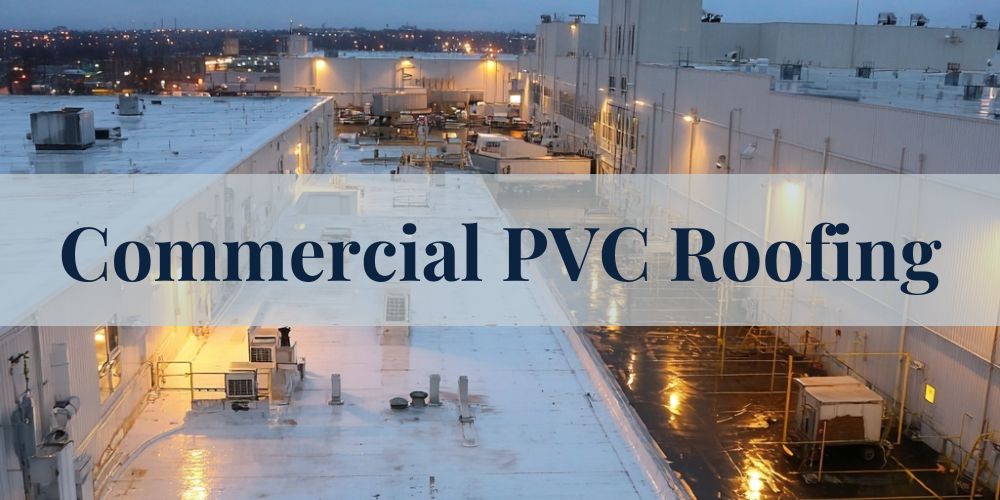
Commercial Roofing New York installs Commercial PVC roofing systems across New York to deliver fire resistant, chemical resistant, and watertight protection for commercial buildings. Commercial PVC roofing is a single ply membrane system designed to provide durable, welded waterproofing in New York’s demanding climate. This system allows Commercial Roofing New York to protect facilities from leaks, chemical exposure, and temperature driven stress without compromising long term performance. Commercial Roofing New York designs PVC roof assemblies to handle New York’s UV exposure, freeze thaw cycles, wind loads, and heavy rooftop foot traffic without seam failure or material breakdown. These membranes resist ponding water and chemical contamination while maintaining a continuous waterproof seal across the roof surface. Commercial Roofing New York uses PVC roofing to keep commercial properties safe, compliant, and operational through every season.
How Does Commercial PVC Roofing Maintain Seam-Level Waterproofing Under New York’s UV, Chemical, and Freeze-Thaw Stress?
New York’s commercial roofs are exposed to a combination of ultraviolet radiation, temperature extremes, and chemical contaminants that rapidly degrade many roofing membranes. On facilities with exhaust systems, grease discharge, or industrial byproducts, airborne chemicals settle on roof surfaces and attack the membrane, while UV and freeze-thaw cycling weaken seams and accelerate cracking. Once a seam fails, water can travel laterally beneath the membrane and compromise large areas of the roof. We install PVC roofing systems because their heat-welded seams create a chemically fused bond that is stronger than the membrane itself. Unlike adhesive-based or taped seams, welded PVC joints do not rely on surface tack or curing; they become a single continuous sheet that resists water, chemicals, and thermal movement. That prevents New York’s ponding water, freeze-thaw cycles, and rooftop contaminants from forcing their way between sheets. Commercial Roofing New York engineers PVC roof assemblies to remain stable under rooftop foot traffic, wind uplift, and solar exposure. The membrane’s plasticizers and reinforced scrims allow it to flex without splitting in cold weather, while its reflective surface reduces heat buildup that would otherwise drive expansion and contraction. That combination keeps seams sealed and the roof watertight through New York’s long summers and harsh winters.
What Is Commercial PVC Roofing and How Is It Used in New York?
Commercial PVC roofing is a single-ply thermoplastic membrane system which is heat-welded together to form a continuous, watertight roof surface. The material is resistant to fire, chemicals, grease, and UV radiation, making it especially durable in demanding commercial environments. In New York, we use PVC roofing on manufacturing facilities, restaurants, warehouses, and other commercial buildings where chemical exposure, ponding water, and rooftop traffic are common. The welded seam technology and material stability allow PVC roofs to maintain long-term waterproofing and regulatory compliance while protecting buildings from moisture and environmental stress year-round.
These PVC material and seam-level engineering features control how chemicals, UV exposure, and thermal movement interact with the roof, producing the following waterproofing outcomes under New York conditions:
- Heat-welded PVC seams → form fused molecular bonds → water cannot penetrate between sheets
- Chemical-resistant membrane surface → repels grease and exhaust residue → contaminants do not weaken seams
- Reinforced scrim layers → stabilize sheet geometry → thermal movement does not distort welds
- UV-stable PVC compounds → resist polymer breakdown → sunlight does not embrittle the membrane
- Reflective membrane surface → lowers rooftop temperature → expansion and contraction stress is reduced
- Flexible plasticizers → allow cold-weather movement → freeze-thaw cycles do not crack the material
- Seam-to-seam fusion → blocks lateral water travel → ponding does not spread leaks beneath the membrane
- Wind-rated attachment systems → hold welded sheets in compression → uplift forces do not peel seams open
Have a question about an upcoming project?
Where Do PVC Roof Systems Hold Their Integrity on New York’s Chemically and Thermally Aggressive Rooftops?
We see PVC roofing perform at its highest level on New York buildings where airborne contaminants, grease, and exhaust residues settle onto roof surfaces and attack traditional membranes. Restaurants, manufacturing plants, and mixed-use facilities expose roofing materials to oils and chemicals that soften adhesives and break down seams. The heat-welded PVC joints we install remain fused even when those contaminants are present, so water cannot slip between sheets and migrate across the roof. Commercial Roofing New York also relies on PVC where thermal cycling and UV exposure would otherwise fatigue lighter membranes. Summer heat expands the roof surface while winter cold contracts it, concentrating stress at seams and penetrations. Because PVC seams are welded into a single continuous sheet, that movement is absorbed by the membrane rather than pulled apart at the joints, keeping New York’s freeze-thaw cycles from creating hidden leak paths. We design these systems for rooftops with frequent foot traffic and mechanical service. Reinforced scrims and puncture-resistant surfaces allow the membrane to tolerate maintenance activity without tearing or abrading through the seam layer. That keeps the welded waterproof plane intact even as New York’s buildings are serviced year after year.
- Heat-welded PVC seams → resist chemical and oil exposure → joints do not soften or separate.
- Thermoplastic membrane → absorbs thermal expansion and contraction → freeze-thaw cycles do not open leak paths.
- Reinforced scrim layer → tolerates foot traffic and equipment loads → seam integrity is not compromised.
- Reflective PVC surface → limits heat buildup → thermal stress on welded joints is reduced.
When Do New York PVC Roofs Need Professional Evaluation?
If your New York PVC roof is exposed to grease exhaust, chemical residue, heavy foot traffic, or prolonged ponding water, even welded seams can begin to lose integrity as plasticizers migrate and surface contaminants interfere with fusion zones. Under freeze-thaw cycling, small seam distortions or surface cracking allow moisture to start moving laterally beneath the membrane, often long before interior leaks appear. We use seam-level inspection, weld testing, and moisture diagnostics to determine whether your PVC system is still maintaining molecular fusion across the roof or if hidden separation and chemical attack are forming leak paths below the surface. If you are seeing membrane discoloration, seam waviness, persistent ponding, or interior moisture, we can evaluate how your PVC roof is performing under real New York UV exposure and thermal cycling and recommend the precise corrective action before seam failure spreads across the system.
When Do New York PVC Roofs Need Professional Intervention?
If your New York building relies on a PVC roof, small seam failures, coating breakdown, or drainage issues can quietly turn into large moisture problems under freeze-thaw and summer heat. We use targeted inspections and material-level repairs to catch those failures before they spread beneath the membrane. If you are seeing staining, ponding, or aging seams, we can evaluate how your roof is performing under real New York conditions and recommend the next step.