
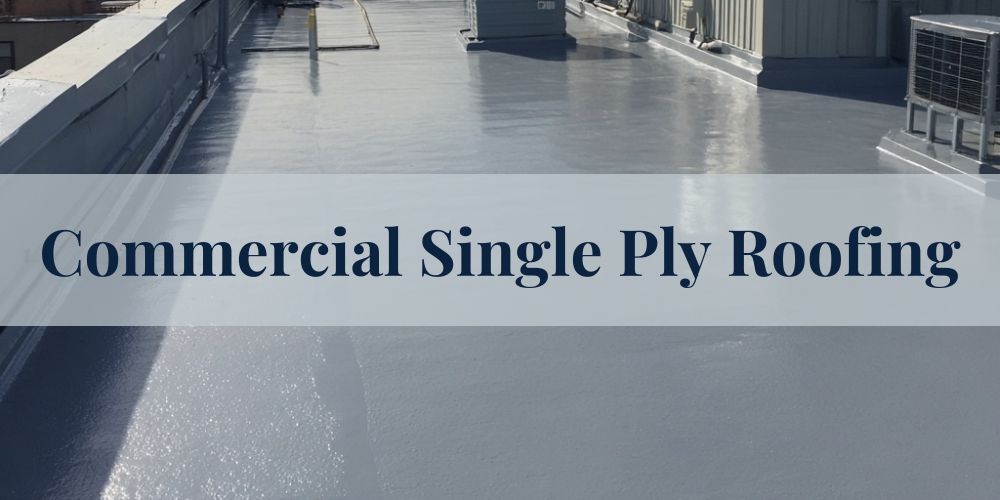
Commercial Roofing New York installs commercial single ply roofing systems across New York to provide watertight, durable, and energy efficient protection for flat and low slope buildings. Commercial single ply roofing is a membrane based roofing system designed to resist leaks, UV damage, and temperature movement in New York’s demanding climate. This allows Commercial Roofing New York to protect commercial properties from weather driven deterioration and long term roof failure. Commercial Roofing New York uses single ply membranes to withstand New York’s UV exposure, heavy rain, freeze thaw cycles, wind loads, and rooftop foot traffic. These roofing systems prevent seam separation, moisture intrusion, and ponding water that commonly damage flat roofs. Commercial Roofing New York applies single ply roofing to keep commercial buildings dry, stable, and fully operational year round.
How Does Commercial Single-Ply Roofing Control Water and Thermal Movement on New York’s Flat Roofs?
New York’s flat and low-slope commercial roofs are constantly exposed to heavy rain, standing water, and wide temperature swings that stress roofing membranes. As heat expands materials in summer and winter cold contracts them, seams and fasteners become prime failure points where moisture can enter and travel beneath the roof surface. Once that water is trapped, freeze-thaw cycles drive it deeper into insulation and decking, accelerating roof failure. We install single-ply roofing systems to create a continuous, flexible waterproof layer that moves with these temperature changes instead of fighting them. The membranes we use are engineered to resist UV degradation, tolerate ponding water, and maintain seam strength under thermal movement. By properly welding or bonding the sheets together, we prevent New York’s weather from forcing water between membrane joints. Commercial Roofing New York designs single-ply roof assemblies to handle the mechanical realities of New York buildings, including rooftop equipment, foot traffic, and wind uplift. Reinforced membranes, secure attachment systems, and properly detailed penetrations allow the roof to remain watertight even as the building expands, contracts, and shifts with the seasons. That keeps flat roofs stable and leak-free year-round.
What Is Commercial Single-Ply Roofing and How Is It Used in New York?
Commercial single-ply roofing is a membrane-based roofing system made from materials such as TPO, PVC, or EPDM which are installed in large sheets to form a continuous waterproof surface. These membranes are either heat-welded or adhered to create sealed seams that protect the roof from moisture and air intrusion. In New York, we use single-ply roofing on flat and low-slope commercial buildings where UV exposure, heavy rain, and freeze-thaw cycling place constant stress on the roof surface. The system’s flexibility, seam strength, and resistance to weathering make it a reliable solution for keeping commercial properties dry, energy efficient, and fully operational throughout the year.
Single-ply roofing performs in New York because its membrane chemistry, seam technology, and attachment methods control how water and thermal movement interact with the roof surface under freeze-thaw and UV exposure.
- Heat-welded or bonded seams → form continuous membrane fields → water cannot migrate between sheets
- Flexible thermoplastic and rubber membranes → expand and contract → thermal movement does not tear the roof open
- UV-resistant formulations → prevent polymer breakdown → sun exposure does not weaken waterproofing
- Ponding-tolerant surfaces → withstand standing water → moisture does not degrade the membrane
- Mechanically fastened or fully adhered systems → resist wind uplift → membranes stay anchored during storms
- Reinforced sheets and flashing details → absorb rooftop traffic and vibration → penetrations do not become leak paths
Have a question about an upcoming project?
Where Do Single-Ply Membranes Stabilize Water and Movement on New York’s Wide Roof Fields?
We see single-ply roofing perform at its highest level on New York buildings with large, uninterrupted roof areas where water and thermal movement have room to spread. Heavy rain and snowmelt move laterally across these surfaces, seeking out weak seams and penetrations. The continuous membranes we install eliminate those pathways by forming a single waterproof plane that directs moisture to drains instead of allowing it to slip between roof layers. Commercial Roofing New York also relies on single-ply systems where temperature swings would tear rigid assemblies apart. As the roof heats and cools, decks and insulation expand and contract at different rates. The membranes and welded seams we use flex with that movement, so stress is absorbed by the material instead of being transferred into openings that let water enter. We design these systems for roofs that support mechanical equipment, foot traffic, and wind uplift. Reinforced membranes and secure attachment methods keep the waterproof layer anchored while distributing loads across the roof surface. That allows New York’s flat roofs to remain watertight and stable even as they are actively used and exposed to seasonal extremes.
- Continuous single-ply membrane → blocks lateral water movement → moisture is directed to drains instead of into the roof.
- Flexible welded seams → absorb thermal expansion and contraction → freeze-thaw cycles do not open joints.
- Reinforced attachment systems → resist wind and mechanical loads → the membrane stays sealed under stress.
- Durable surface layer → tolerates UV and foot traffic → waterproofing is preserved over time.
When Do New York Single-Ply Roofs Need Professional Evaluation?
If your TPO, PVC, or EPDM roof is showing seam separation, surface wrinkling, persistent ponding, or interior staining, New York’s thermal cycling and rainfall may already be forcing water beneath the membrane. As single-ply sheets expand in summer and contract in winter, weakened seams and stressed fasteners can open microscopic pathways that allow moisture to migrate laterally across insulation and decking. We evaluate how your single-ply system is responding to New York’s UV exposure, freeze-thaw movement, and standing water to determine whether its seams, attachments, and membrane chemistry are still performing as designed. If welds are beginning to fatigue or the membrane is losing flexibility, we can identify exactly where waterproofing is breaking down and recommend the precise next step before small defects become widespread roof failure.