
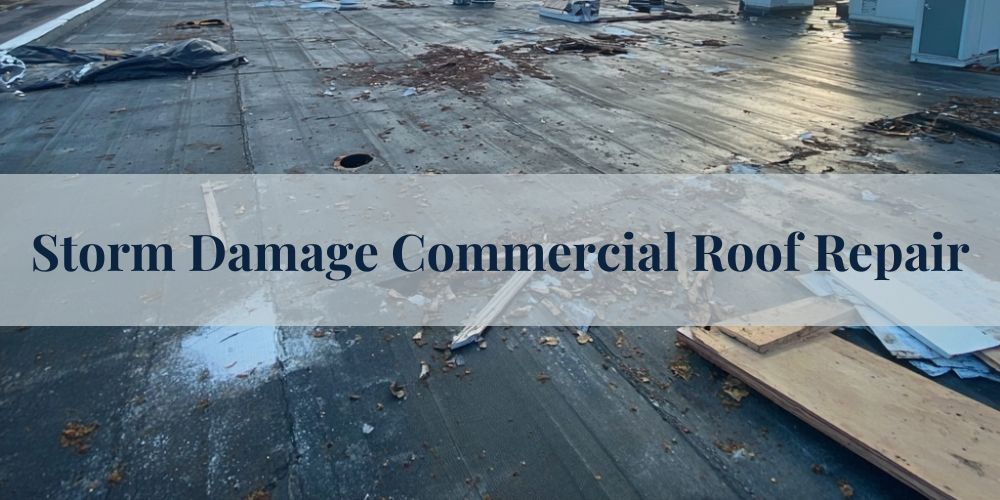
Commercial Roofing New York provides storm damage commercial roof repair across New York to restore waterproofing, structural safety, and building performance after severe weather. Storm damage roof repair is the correction of wind, rain, and impact related roof failures caused by New York’s extreme weather conditions. This service allows Commercial Roofing New York to stop leaks, prevent further deterioration, and return commercial properties to full operation quickly. Commercial Roofing New York repairs roofs damaged by New York’s high winds, heavy rain, UV exposure, freeze thaw cycles, and wind driven debris. These conditions cause membrane tears, seam failures, and drainage problems that require immediate professional repair. Commercial Roofing New York uses storm damage repair to keep commercial buildings safe, dry, and fully functional after every major weather event.
How Does Storm Damage Roof Repair Stop Water and Structural Failure After New York’s Severe Weather?
New York storms subject commercial roofs to extreme wind uplift, driving rain, flying debris, and rapid pressure changes that tear membranes, break seams, and dislodge flashings. Once these components are compromised, water is forced beneath the roof surface, where it spreads through insulation and decking, creating structural risk long after the storm has passed. Freeze-thaw cycling then accelerates this damage by expanding trapped moisture and reopening repaired areas. We perform storm damage repairs to immediately restore the roof’s waterproof and load-bearing functions. Torn membranes are reinforced, open seams are resealed, and damaged flashings and drainage components are rebuilt so water cannot continue migrating through the roof assembly. By sealing the roof at every breach point, we prevent New York’s post-storm rainfall and melting ice from turning temporary damage into permanent structural failure. Commercial Roofing New York designs storm repairs to withstand both emergency conditions and long-term climate stress. The materials we use resist UV exposure, thermal movement, and mechanical loading so the repaired roof can survive future storms as well as everyday New York weather. That ensures commercial buildings remain safe, dry, and fully operational after even the most severe events.
What Is Storm Damage Commercial Roof Repair and How Is It Used in New York?
Storm damage commercial roof repair is the process of restoring a roof after it has been compromised by wind, rain, hail, or debris impact. This includes repairing torn membranes, replacing damaged components, reinforcing seams, and correcting drainage failures caused by severe weather. In New York, we use storm damage repair to stabilize roofs immediately after extreme weather so leaks, insulation damage, and structural deterioration do not continue. By addressing storm-related failures at their source, we return commercial properties to full weather protection and operational stability as quickly as possible.
These storm-recovery actions produce the following material-level performance outcomes:
- Torn membrane reinforcement → restores continuous waterproofing → storm-driven rain cannot migrate beneath the roof
- Resealed seams and laps → reestablish tensile continuity → wind pressure does not reopen joints
- Rebuilt flashing systems → stabilize edge and penetration zones → water cannot enter at movement points
- Drain and scupper restoration → reopens flow paths → post-storm ponding does not force infiltration
- Impact-resistant repair materials → absorb debris strikes → new punctures do not form during future storms
- Elastic repair compounds → flex with thermal cycles → freeze-thaw movement does not fracture repairs
Have a question about an upcoming project?
How Do Modified Bitumen Roofs Survive New York’s Ponding Water, Foot Traffic, and Seasonal Movement?
On New York’s low-slope commercial buildings, most roof failures do not begin with a dramatic storm — they start with standing water and daily mechanical abuse. Wide roof fields allow snowmelt and rain to sit for days around drains, HVAC curbs, and parapet walls. At the same time, maintenance crews, service carts, and snow removal repeatedly compress and scrape the membrane surface. On thinner roofing systems, this combination creates abrasion, seam fatigue, and slow water intrusion that spreads through insulation and deck layers long before a visible leak appears. We build modified bitumen systems to interrupt that failure pattern. The membrane’s multi-ply structure distributes loads across the roof surface instead of concentrating them at a single sheet. When water ponds, it rests on multiple bonded asphalt layers instead of pushing directly against a thin membrane, reducing hydraulic pressure on seams and penetrations. When foot traffic or equipment rolls across the roof, the reinforced plies absorb the impact so surface wear does not propagate into the waterproofing layers below. Commercial Roofing New York designs modified bitumen installations around where New York roofs actually fail — at drains, curbs, expansion joints, and equipment zones. We thicken and reinforce these stress points so ponded water, vibration, and seasonal movement cannot open pathways into the roof assembly. That layered, load-sharing structure is what allows modified bitumen roofs to keep water out and structural components dry even under constant environmental and operational stress.
- Multi-ply asphalt layers → distribute hydraulic pressure → ponded water does not force seams open.
- Reinforced cap sheets → resist abrasion → foot traffic does not reach the waterproof core.
- Bonded interlayers → block lateral flow → moisture cannot migrate beneath the surface.
- Thickened flashings and curbs → absorb vibration and movement → equipment zones remain sealed.
- Redundant membrane structure → tolerate surface damage → deck and insulation stay protected.
When Do New York Storm-Damaged Roofs Need Immediate Professional Repair?
If your building was exposed to high winds, wind-driven rain, or flying debris, moisture may already be moving beneath the roof even if interior leaks have not appeared yet. Torn membranes, lifted seams, and displaced flashings allow New York’s post-storm rainfall and freeze-thaw cycles to rapidly expand hidden damage inside insulation and decking. We assess how storm forces have altered the roof’s waterproofing and load paths, not just what is visible on the surface. If your roof has experienced severe weather, we can determine whether emergency stabilization or full storm-grade repair is required to stop structural and moisture damage before it escalates.